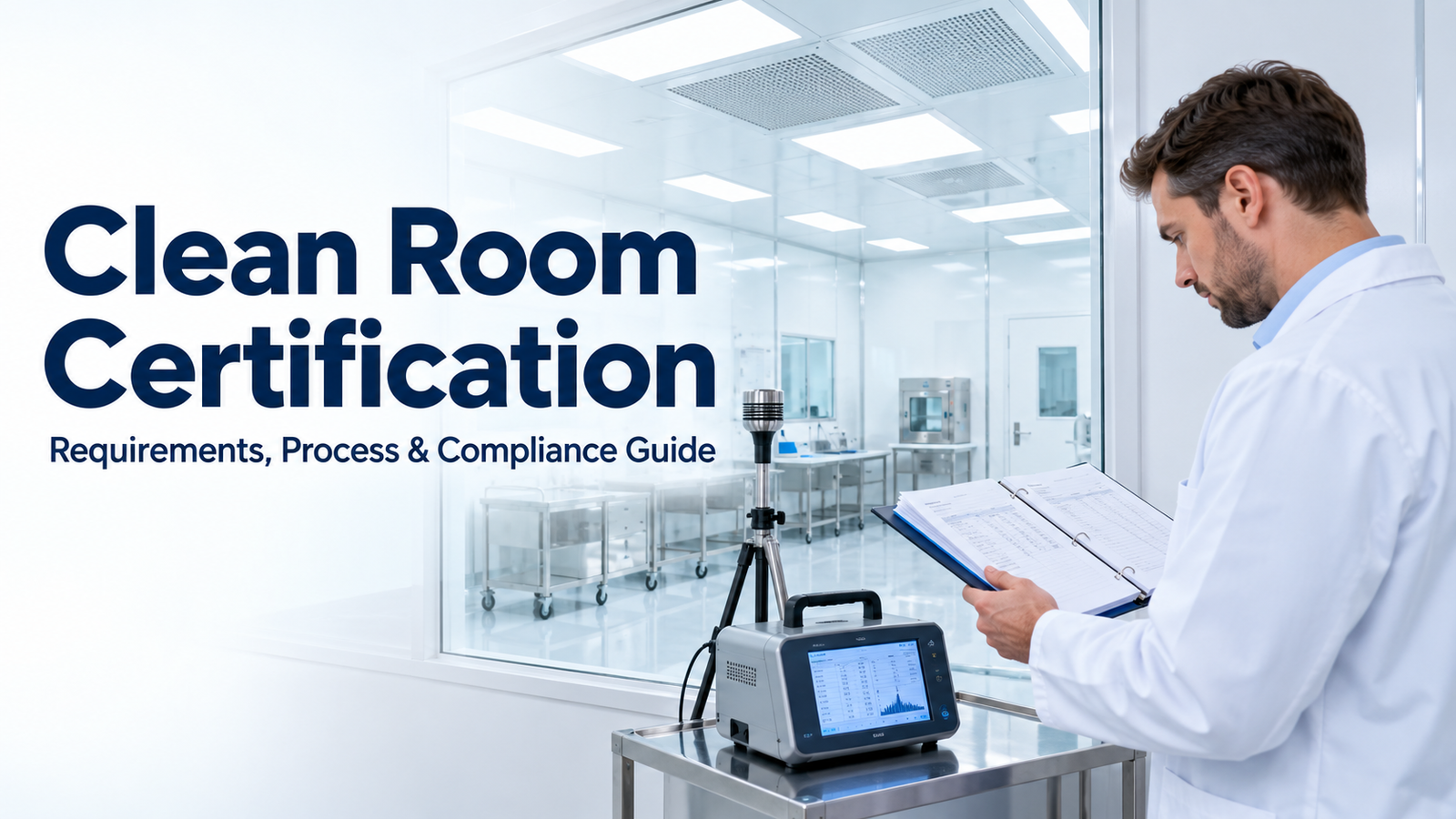
Clean Room Certification: Requirements, Process & Compliance Guide
Clean room certification is the formal confirmation, backed by measured results, that a controlled environment meets the cleanliness class it is required to hold. A certificate is more than paperwork — it is documented, accredited proof that a cleanroom’s air, airflow and filtration perform to ISO 14644 limits, and it is exactly what auditors, customers and regulators ask to see.
This guide explains what clean room certification involves, the requirements behind it, the tests that support it, the standards it follows, and how a facility becomes certified.
Table of contents
- What is clean room certification?
- Why certification matters
- Certification requirements
- Tests behind the certificate
- The certification process
- Standards and compliance
- FAQs
What is clean room certification?
Clean room certification is the process of testing a cleanroom against its designed ISO class and issuing an accredited certificate that records the result. The certificate states the room, its class, the tests performed, the measured values and the pass or fail against each limit.
Certification draws on the same measurements as routine clean room testing, but the emphasis is on producing a defensible, accredited record that the room can present to any third party.
Why clean room certification matters
For regulated and quality-driven operations, a certificate is the currency of trust:
- Regulatory compliance — inspectors expect current certification for classified areas.
- Customer confidence — clients auditing your facility want proof, not promises.
- Product and patient safety — certified control protects sterile products and vulnerable people.
- Contract eligibility — many contracts require a valid cleanroom certificate.
Clean room certification requirements
To be certified, a cleanroom must demonstrate that it meets defined criteria:
- A stated ISO class (for example ISO Class 7 or 8) and acceptance limits.
- Airborne particle counts within the class limit at defined sample points.
- Correct airflow, air changes per hour and, where required, unidirectional flow.
- Intact HEPA filters and the correct differential pressure cascade.
- Testing carried out by an accredited laboratory using calibrated, traceable instruments.
Tests behind the certificate
A certificate is only as strong as the measurements behind it. Certification typically covers:
- Airborne particle count against the ISO 14644 class.
- Airflow velocity and air changes per hour.
- HEPA filter integrity to confirm no leaks.
- Differential pressure between adjoining areas.
- Recovery, temperature and humidity where specified.
The certification process
- Define the scope — agree the rooms, ISO class and acceptance criteria.
- Verify instruments — confirm every meter is calibrated and traceable.
- Perform the tests — measure particles, airflow, pressure and filter integrity.
- Assess against limits — compare every result with the class requirement.
- Issue the certificate — document results, pass or fail, and the certification date.
- Re-certify on schedule — repeat at the required interval to keep the certificate valid.
Standards and compliance
Certification is anchored in recognised standards, applied only where they genuinely fit:
- ISO 14644 — the international series for cleanroom air cleanliness and test methods (ISO 14644 overview).
- GMP — Good Manufacturing Practice for pharmaceutical environments.
- NABL / ISO/IEC 17025 — accreditation and competence for the certifying laboratory.
We never invent limits or accreditation — only verified requirements appear on a certificate.
Industries that need certification
- Pharmaceutical and biotechnology — sterile manufacturing and filling.
- Hospitals and healthcare — operating theatres and sterile stores.
- Medical device manufacturing and laboratories.
- Electronics and precision manufacturing.
How often should a cleanroom be re-certified?
Re-certification frequency depends on the ISO class and regulatory framework. Many facilities re-certify every 6 to 12 months, with more critical rooms tested more often. A certificate has a validity period, and testing must be repeated before it lapses. This ongoing cycle is what a cleanroom validation programme delivers.
Choosing a certification provider
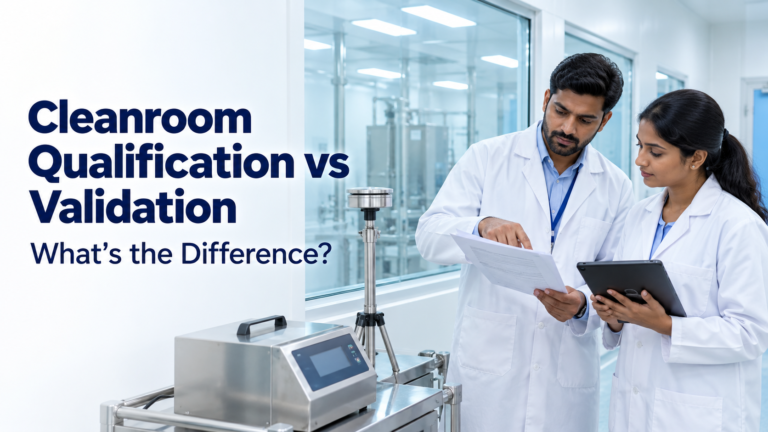
Choose an accredited partner with calibrated, traceable instruments and clear, defensible certificates. NABL accreditation, on-site capability and experience across pharma, healthcare and laboratories all matter. Certification also pairs naturally with clean room qualification for new rooms.
Common reasons a cleanroom fails certification
Understanding why rooms fail helps you prepare before the certification visit. The usual causes are:
- Loaded or damaged HEPA filters — a leak lets particles bypass filtration.
- Insufficient air changes — the room cannot clear contamination fast enough.
- Lost pressure cascade — a door left open or a fan fault reverses the pressure difference.
- Poor housekeeping or gowning — procedures, not just hardware, affect particle counts.
Most of these are correctable once identified, which is why a pre-certification check often saves time and cost.
Frequently asked questions
What is clean room certification in simple terms?
It is accredited proof, backed by measurements, that a cleanroom meets its required ISO cleanliness class.
What does a cleanroom certificate include?
The room, its ISO class, the tests performed, the measured results and a pass or fail against each limit, plus the certification date.
How long is a cleanroom certificate valid?
Validity depends on the class and framework — commonly 6 to 12 months. Re-testing is needed before it expires.
Who can certify a cleanroom?
An accredited testing laboratory using calibrated, traceable instruments — ideally NABL / ISO/IEC 17025 accredited.
Do you provide NABL-accredited clean room certification?
Yes. Vanavil Calibrations carries out NABL-accredited testing and certification on-site across Tamil Nadu.
Conclusion
Clean room certification turns a cleanroom’s performance into accredited, documented proof. By testing particles, airflow, pressure and filter integrity against ISO 14644 and issuing a defensible certificate, certification keeps hospitals, pharmaceutical plants and laboratories compliant, trusted and inspection-ready — and it must be renewed on schedule to stay valid.
Need a valid cleanroom certificate? Contact our team today. Vanavil Calibrations provides NABL-accredited clean room testing and certification across Tamil Nadu with clear, audit-ready reports. Get in touch to certify your facility.
2 Comments