Airflow Velocity Testing: Methods, Instruments and Standards
Airflow velocity testing measures how fast and how evenly air moves through a cleanroom or clean-air device. Air speed drives everything from unidirectional flow to how quickly contamination is swept away, so airflow velocity testing gives the measured evidence that a controlled space is moving air the way its design requires.
This guide explains what airflow velocity testing involves, the parameters and instruments used, the process, and the standards behind it.
Table of contents
- What is airflow velocity testing?
- Why airflow velocity testing matters
- What it measures
- Instruments and method
- The testing process
- Standards and compliance
- FAQs
What is airflow velocity testing?
Airflow velocity testing is the on-site measurement of air speed at defined points in a cleanroom, filter face or clean-air device. It confirms that air is moving at the intended velocity and with enough uniformity to maintain the room’s cleanliness, and it is a core part of any clean room performance testing visit.
Velocity readings also feed the calculation of air volume and, from there, the air changes per hour that a room achieves.
Why airflow velocity testing matters
- Maintains unidirectional flow — the right velocity keeps clean air moving in one direction where it is required.
- Clears contamination — adequate air movement sweeps particles away from the work.
- Supports other results — velocity underpins air-change and recovery performance.
- Flags weakening airflow — a tiring fan or loaded filter shows up as falling velocity.
What airflow velocity testing measures
- Air velocity — the speed of air at each measurement point.
- Uniformity — how consistent the velocity is across the plane or filter face.
- Airflow direction — whether flow is unidirectional where required.
- Derived air volume — velocity combined with area gives the volume for air-change calculations.
Only the criteria that genuinely apply to the room or device are used — no invented limits.
Instruments and method
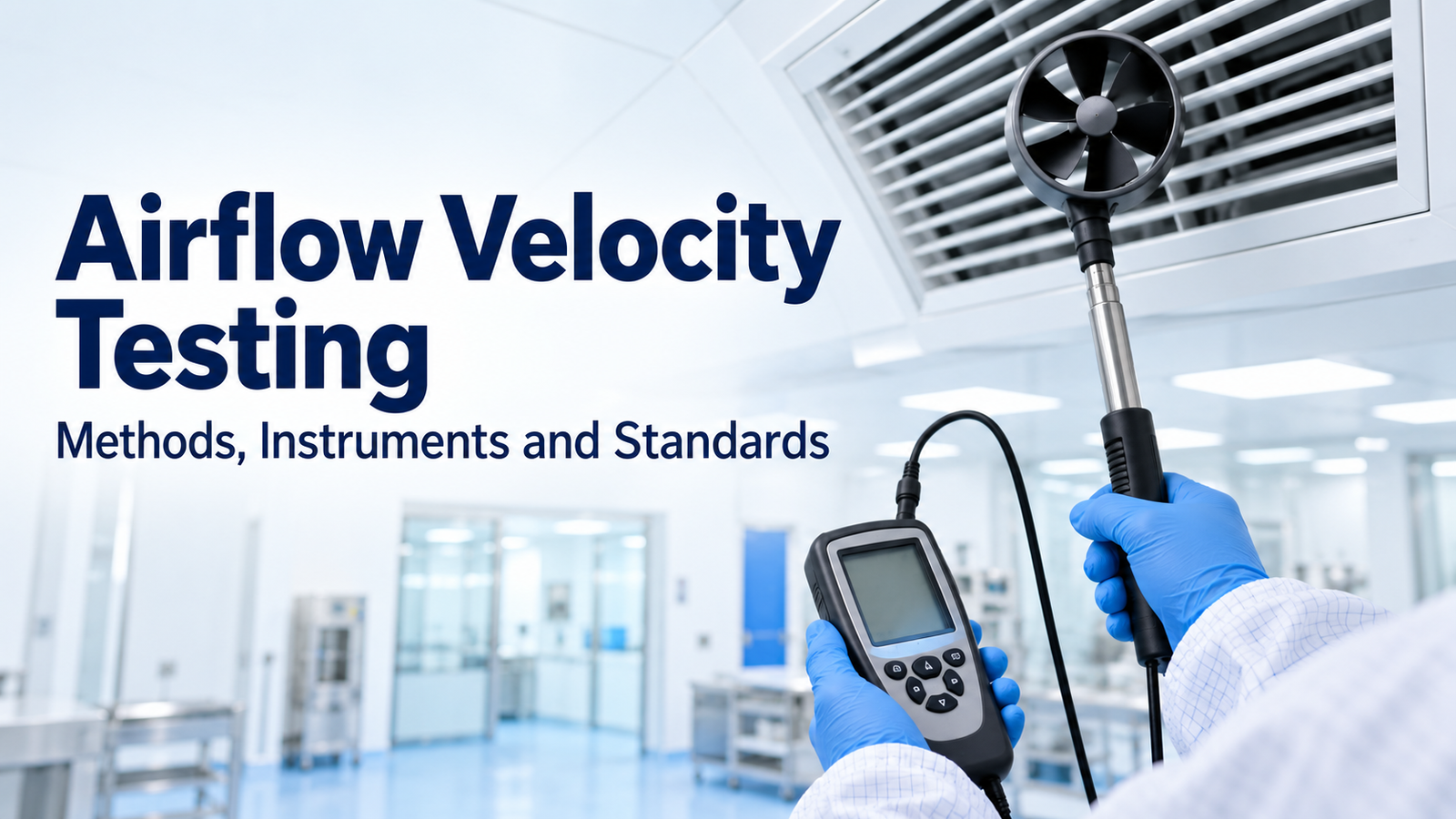
- Thermal anemometers measure low air speeds accurately at each point.
- Vane anemometers read velocity at supply grilles and larger openings.
- Balometers (flow hoods) capture total volume at a diffuser.
- A measurement grid ensures readings represent the whole plane, not one spot.
Because each reading may support a compliance record, calibrated, traceable instruments are essential.
The airflow velocity testing process
- Define the scope — agree the planes, points and acceptance criteria.
- Verify instruments — confirm calibration and traceability.
- Measure on a grid — record velocity at each defined point.
- Assess uniformity — check the spread of readings across the plane.
- Report — document the values, average and a pass or fail against the limits.
Standards and compliance
- ISO 14644 — cleanroom air cleanliness and test methods, including airflow (ISO 14644 overview).
- GMP — Good Manufacturing Practice for pharmaceutical environments.
- NABL / ISO/IEC 17025 — accreditation for the testing laboratory.
Airflow velocity and air changes
Velocity is closely tied to air changes per hour: multiplying the average velocity by the supply area gives the air volume, and dividing that volume by the room volume gives the number of air changes. Accurate velocity readings are therefore the foundation of a reliable air-change result.
How often should airflow velocity be tested?
Frequency depends on the room’s class and framework. Many facilities check airflow velocity at every routine visit and after any change to fans or filters, as part of their wider clean room testing programme.
Common mistakes to avoid
- Measuring at one point — a grid is needed to judge uniformity.
- Ignoring instrument position — distance from the filter changes the reading.
- Uncalibrated anemometers — results become indefensible.
- Testing only velocity — pair it with particle and pressure results.
Frequently asked questions
What is airflow velocity testing in simple terms?
It is measuring how fast and how evenly air moves in a cleanroom or clean-air device, at defined points across a plane.
Why is air velocity important in a cleanroom?
It maintains unidirectional flow, sweeps contamination away and underpins air-change and recovery performance.
What instruments are used?
Thermal and vane anemometers for velocity and balometers for volume, all calibrated and traceable.
How does velocity relate to air changes?
Average velocity multiplied by area gives air volume, which divided by room volume gives the air changes per hour.
Do you provide NABL-accredited airflow velocity testing?
Yes. Vanavil Calibrations carries out NABL-accredited airflow velocity testing on-site across Tamil Nadu.
Conclusion
Airflow velocity testing turns air movement into measured evidence. By recording velocity and uniformity across a defined grid against ISO 14644 methods, it underpins unidirectional flow, air changes and recovery — keeping cleanrooms in hospitals, pharmaceutical plants and laboratories performing to their class.
Need your airflow verified? Contact our team today. Vanavil Calibrations provides NABL-accredited airflow velocity and clean room testing across Tamil Nadu with clear, audit-ready reports. Get in touch to schedule your testing.