Cleanroom Qualification vs Validation: What’s the Difference?
“Do we need qualification or validation?” is one of the most common questions facility teams ask — and the answer matters for compliance. Understanding cleanroom qualification vs validation helps you commission new spaces correctly and keep existing ones audit-ready.
This guide explains what each term means, how they differ, which one your facility needs, and why auditors care about the distinction — without the jargon.
Table of contents
- What is cleanroom qualification?
- What is cleanroom validation?
- The key difference
- Which do you need?
- FAQs
What is cleanroom qualification?
Cleanroom qualification is the one-time process of confirming a new or modified cleanroom is built and performing as designed before it goes into routine use. It proves the room meets its intended ISO 14644 classification from day one.
The IQ / OQ / PQ structure
Qualification usually follows three stages:
- Installation Qualification (IQ) — confirms the room and equipment are installed correctly to specification.
- Operational Qualification (OQ) — confirms the room performs correctly across its operating range.
- Performance Qualification (PQ) — confirms the room holds its classification under real working conditions.
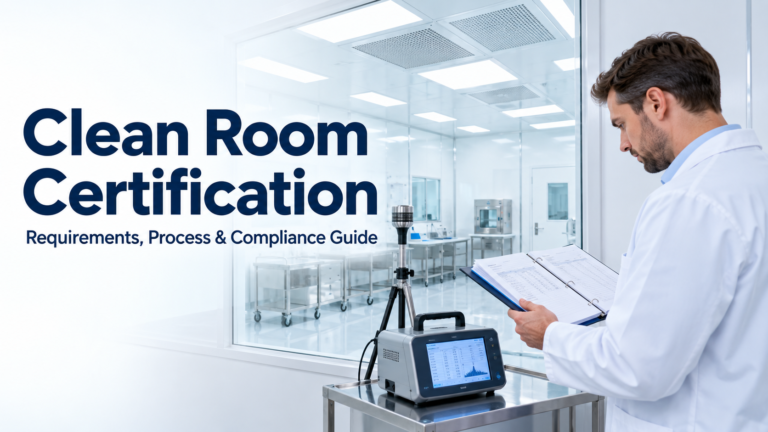
See our clean room qualification service for the full scope of each stage.
What is cleanroom validation?
Cleanroom validation is the ongoing, recurring discipline of re-confirming that a room continues to meet its classification over time. It is a scheduled programme — consistent test procedures, defined intervals and a documented history — not a single snapshot.
Validation reuses the same core measurements as routine testing — particle counts, airflow, HEPA integrity and pressure — but ties them into a repeatable schedule that auditors can follow. Our cleanroom validation service is built around exactly this schedule.

Cleanroom qualification vs validation: the key difference
The simplest way to separate the two is by timing and purpose:
- Timing — qualification happens once, before use; validation recurs on a schedule.
- Purpose — qualification proves the room was built right; validation proves it stays right.
- Frequency — qualification is a project; validation is a routine.
- What auditors look for — not just “was it tested,” but “is there a validation programme.”
In short, the cleanroom qualification vs validation question is really about when and how often the same checks are performed and documented.
What both share: the core measurements
It helps to remember that qualification and validation are not different tests — they use the same underlying measurements. The difference is the framework around them. Both typically cover:
- Airborne particle counts against the room’s ISO class.
- Airflow velocity, pattern and air changes per hour.
- HEPA filter integrity and differential pressure.
- Temperature and humidity where specified.
If you want a refresher on the measurements themselves, see our guide to clean room testing.
Why the difference matters for compliance
Auditors do not just want a one-off certificate. They want evidence that a room was proven fit at start-up and that a programme keeps it fit. A cleanroom that was qualified years ago but never revalidated is a common audit finding.
Getting the qualification vs validation distinction right protects you from exactly that gap. Both are framed by the same standard family — the ISO 14644 series — and, for pharmaceutical sites, by GMP expectations.
Which do you need?
It depends on where your cleanroom is in its lifecycle:
- A new or modified cleanroom needs qualification first, then enters a validation schedule.
- An existing operational cleanroom needs an ongoing validation programme.
Most facilities need both over the life of a room — qualification once, validation forever after.
Cleanroom qualification vs validation at a glance
If you only remember one thing about cleanroom qualification vs validation, make it this: qualification is a one-time event and validation is a repeating cycle. Qualification answers “was this room built and commissioned correctly?” Validation answers “is this room still in control today, and can we prove it?” A compliant facility can always answer both.
A simple way to remember it
Think of a new car. Qualification is the factory sign-off and first road test that proves the car was built correctly and drives as designed. Validation is the regular service schedule that keeps it roadworthy for years afterwards.
Apply the same logic to a controlled room: qualification is the proof at the start, and validation is the routine that maintains that proof. That is the whole cleanroom qualification vs validation story in one picture — build it right, then keep proving it stays right.
Documentation and records
Whichever stage you are in, the paperwork is as important as the measurement. Qualification produces a protocol and a signed report showing the room met its design at start-up. Validation builds a running history of scheduled reports, so any drift is visible over time. Together they give a complete, inspection-ready record for the life of the cleanroom.
Frequently asked questions
Is qualification or validation done first?
Qualification comes first. A new room is qualified before use, and then it enters a recurring validation schedule to prove it stays in control.
Does a new cleanroom need both?
Yes. It is qualified once at commissioning, then validated on a regular schedule for the rest of its working life.
How often is validation carried out?
Validation intervals depend on ISO class and regulatory framework — commonly every 6 to 12 months, with some parameters checked at each visit.
Is cleanroom qualification vs validation just a naming difference?
No. They are genuinely different activities: qualification is a one-time proof at start-up, while validation is the recurring programme that keeps the room compliant.
Can one provider handle both?
Yes. Vanavil Calibrations provides both qualification and validation, so you get one NABL-accredited partner for the full lifecycle.
Conclusion
The cleanroom qualification vs validation question comes down to timing: qualification proves a new room was built and performs as designed, while validation is the ongoing schedule that proves it stays that way. New rooms need qualification first and then a validation programme; existing rooms need validation to remain audit-ready.
Getting both right keeps hospitals, pharmaceutical plants and laboratories compliant, safe and inspection-ready year after year.
Not sure which your facility needs? Contact us today. Vanavil Calibrations provides both NABL-accredited qualification and validation across Tamil Nadu. Talk to our team about your cleanroom.