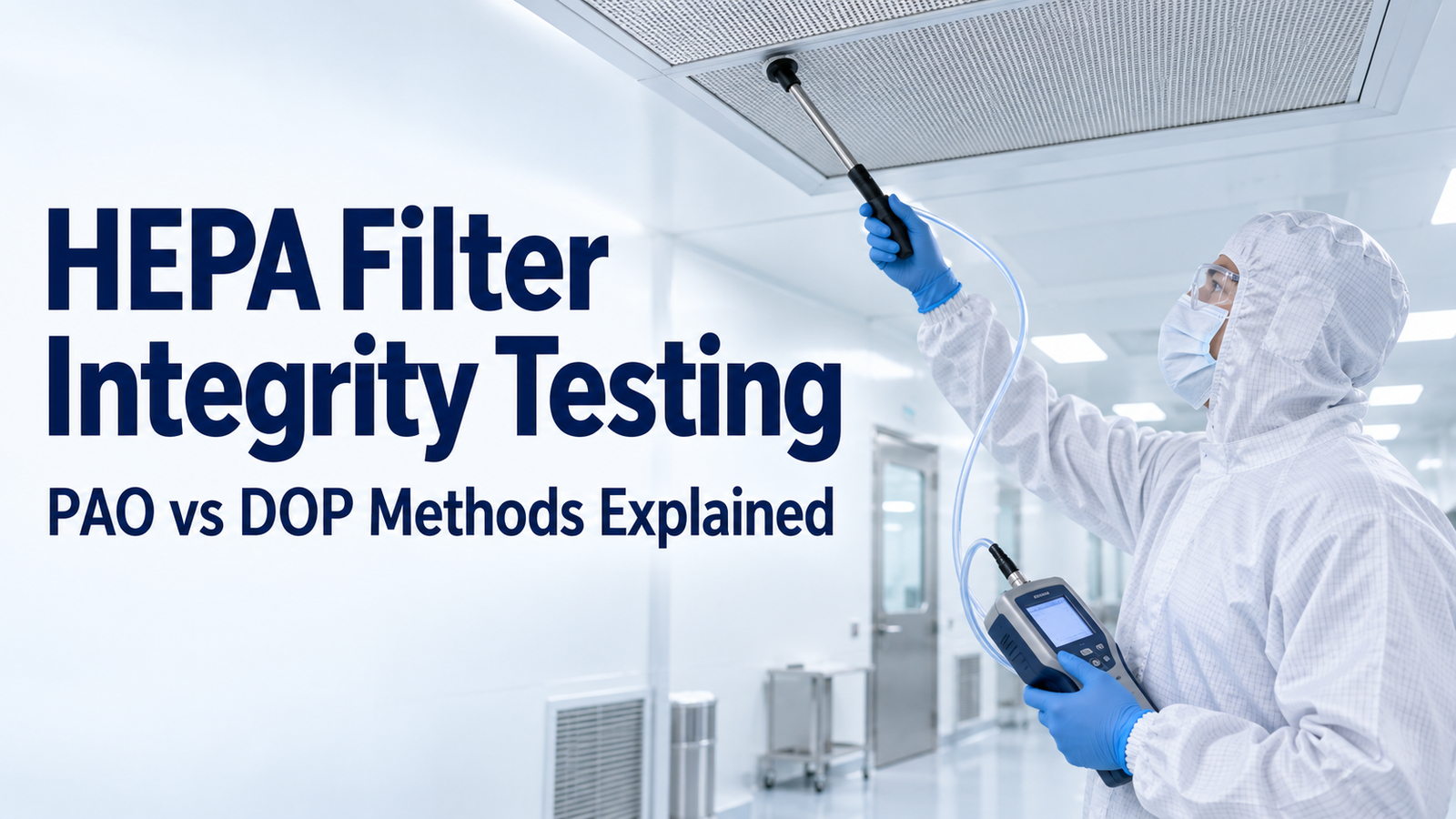
HEPA Filter Integrity Testing: PAO vs DOP Methods Explained
A cleanroom is only as clean as its filters. HEPA filter integrity testing confirms that a high-efficiency filter — and the seal around it — is actually stopping the particles it is meant to. Two aerosol methods dominate the field: the DOP test and the PAO test. This guide explains how HEPA filter integrity testing works and how the two methods compare.
Why HEPA filter integrity testing matters
A pinhole leak in a HEPA filter, or a gap in its gasket, lets contaminated air bypass filtration entirely — undermining everything downstream. The test challenges the filter with a fine aerosol and scans the downstream face to detect leaks that particle counts alone can miss.
For regulated environments, this matters because:
- Leaks are invisible — a filter can look perfect and still fail.
- Room counts can hide local faults — a single leaking spot may not raise the overall particle count until it is serious.
- Auditors expect proof — a scan report documents that every filter and seal is intact.
See our HEPA filter integrity testing service for the full scope.
What is the DOP test?
The DOP test is the original HEPA leak-test method, named after the DOP aerosol traditionally used as the challenge. A polydisperse aerosol is introduced upstream of the filter, and a photometer scans the downstream side for penetration above the acceptance limit.
It is a proven, well-understood method, but the traditional DOP oil raised health and handling concerns, which drove the move toward a safer alternative.
What is the PAO test?
The PAO test uses PAO (poly-alpha-olefin) as a safer, more stable challenge aerosol while following the same scanning principle. Because of the health and stability concerns around older DOP oils, PAO has become the widely preferred challenge medium for modern HEPA filter integrity testing.

PAO vs DOP: the key differences
Both methods share the same goal, but differ in the challenge aerosol:
- Aerosol — DOP uses the traditional oil; PAO uses a safer, more stable alternative.
- Method — both use an upstream challenge and downstream photometer scanning.
- Preference — PAO is now generally favoured on safety and consistency grounds.
- Results — when performed correctly, both reliably locate leaks to the same acceptance limits.
How the test is performed
Whichever aerosol is used, the process follows the same core steps:
The typical procedure
- Introduce the challenge aerosol upstream of the filter at a known concentration.
- Scan the downstream face and frame with a photometer probe at a controlled speed.
- Compare penetration against the acceptance limit to identify any leak.
- Document the result and, where a leak is found, retest after repair.
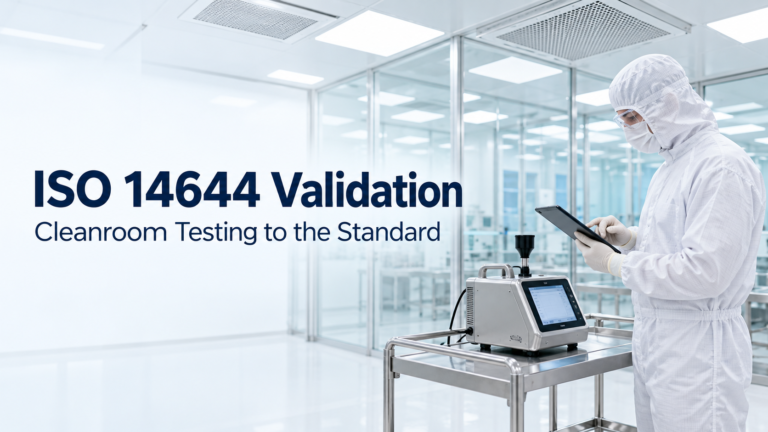
Methods for filter leak testing are described in the ISO 14644-3 series on cleanroom test methods.
Acceptance criteria: what counts as a pass?
A HEPA filter installation typically passes when downstream penetration stays below a defined limit — commonly around 0.01% of the upstream challenge concentration for a standard HEPA grade. A reading above the limit at any point marks a leak that must be addressed.
Because the probe scans the whole face and frame, the test locates where the leak is — in the medium, at a seal, or in the gasket — which decides whether it can be repaired or the filter must be replaced.
When should HEPA filters be tested?
Integrity testing is not a one-off. Filters should be checked:
- At installation — to prove a new filter and seal are sound.
- On a regular schedule — commonly annually for most classified areas.
- After any disturbance — whenever a filter is replaced, moved or worked near.
The test is usually carried out alongside clean room testing and forms part of a full cleanroom testing programme.
Common causes of HEPA filter leaks
Understanding why filters fail helps you plan the right testing interval. The usual causes are:
- Shipping and handling damage — a pinhole or tear created before the filter is even installed.
- Gasket or seal gaps — the frame is sound but air escapes around the edge.
- Ageing media — the filter medium degrades or loosens over years of service.
- Vibration and pressure shocks — nearby work or sudden pressure changes open a small breach.
Because most of these are invisible, HEPA filter integrity testing is the only dependable way to catch them before they affect the product or patient. Planning the interval around these risks — installation, routine schedule and any disturbance — keeps every filter accounted for and every result on record.
Frequently asked questions
What is HEPA filter integrity testing?
It is a leak test that challenges a HEPA filter with a fine aerosol and scans the downstream side to confirm no contaminated air is bypassing the filter or its seal.
What is the difference between PAO and DOP?
They are different challenge aerosols used in the same scanning method. DOP is the traditional oil; PAO is a safer, more stable alternative that is now widely preferred.
How often should HEPA filters be integrity tested?
Commonly once a year, and always after a filter is replaced or disturbed. Critical processes may require more frequent testing.
Is a leaking HEPA filter always replaced?
Not always. Small gasket or seal leaks can sometimes be repaired and retested; damaged filter medium usually needs replacement.
Do you offer NABL-accredited HEPA filter integrity testing?
Yes. Vanavil Calibrations performs NABL-accredited testing on-site across Tamil Nadu.
Conclusion
HEPA filter integrity testing is the check that proves your last line of defence against contamination is intact. By challenging each filter with a PAO or DOP aerosol and scanning for penetration, it finds the hidden leaks that particle counts alone can miss.
Both methods work; PAO is simply the safer, more consistent choice most facilities now prefer. Either way, the outcome is the same — documented proof that every filter and seal is doing its job.
Contact us today for HEPA filter integrity testing. Vanavil Calibrations performs NABL-accredited testing on-site across Tamil Nadu with clear scan reports. Request a quote for your filters.