Lux Level Measurement: Lighting Testing Methods and Standards
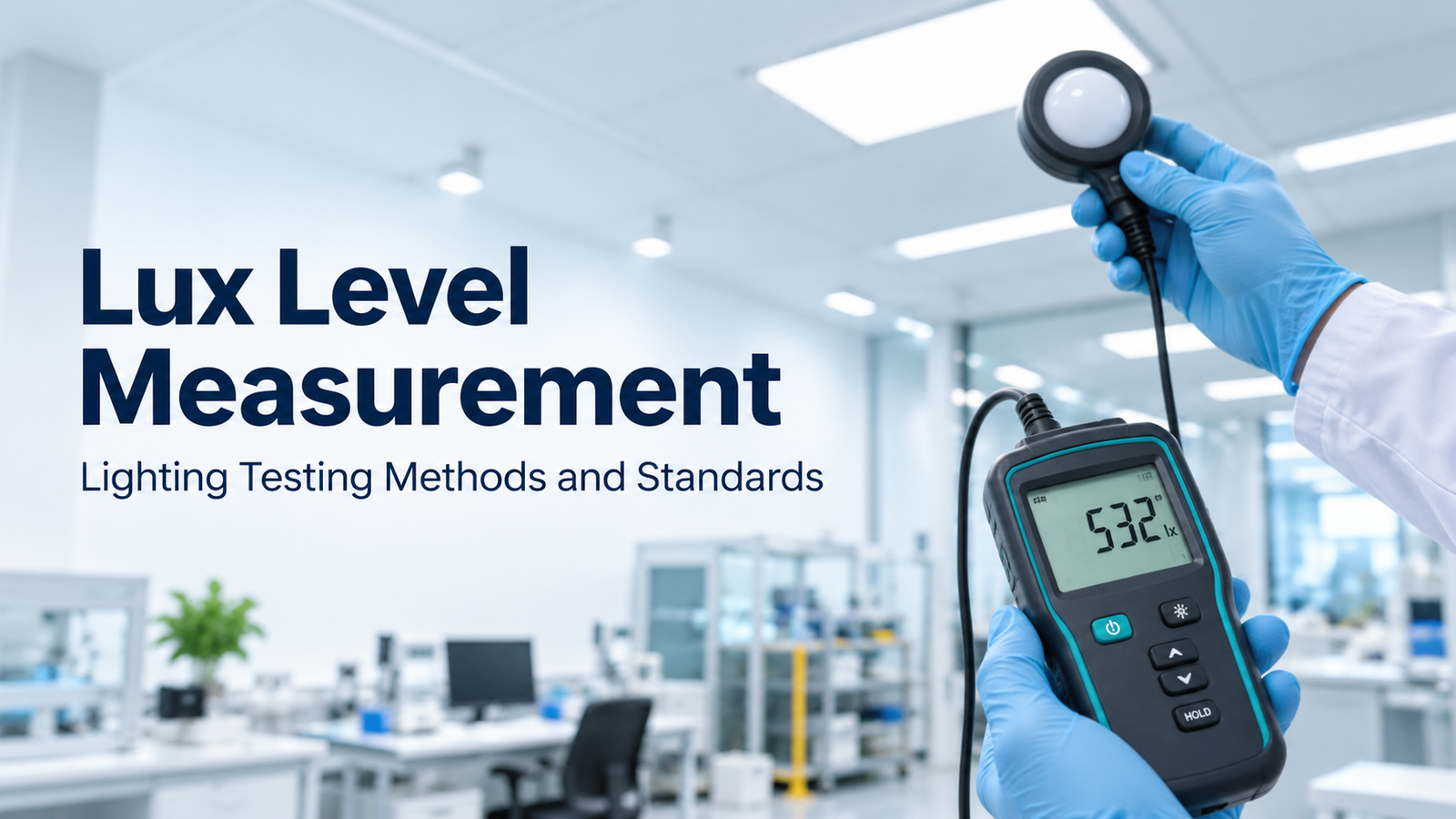
Lux level measurement checks how much light actually reaches a work surface, so that people can see clearly, work accurately and stay safe. Lighting that looks bright to the eye can still fall short of what a task needs, so lux level measurement uses a calibrated meter to turn illumination into a number that can be compared with a requirement.
This guide explains what lux level measurement involves, why lighting matters in controlled areas, the method and instruments, and the standards that apply.
Table of contents
- What is lux level measurement?
- Why lighting levels matter
- What it measures
- Instruments and method
- The measurement process
- Standards and compliance
- FAQs
What is lux level measurement?
Lux level measurement, or illuminance measurement, is the recording of light intensity in lux at defined points across a space. One lux is one lumen per square metre, so the reading shows how well a surface is actually lit. In cleanrooms, laboratories and production areas it is often measured as part of routine clean room performance testing and workplace assessment.
Why lighting levels matter
- Accuracy of work — fine tasks and visual inspection need enough light.
- Safety — adequate lighting reduces errors and accidents.
- Compliance — many areas have a specified minimum illumination.
- Comfort and productivity — good lighting reduces eye strain and fatigue.
What lux level measurement measures
- Illuminance in lux — the light reaching each measured point.
- Uniformity — how evenly the light is spread across the area.
- Task-area lighting — the level where the actual work is done.
- Comparison with the requirement — against the specified minimum for the space.
Only the lighting level that genuinely applies to a space and its task is used — no invented figures.
Instruments and method
- Calibrated lux meters (photometers) read illuminance directly.
- A measurement grid at work-surface height represents the whole area.
- Controlled conditions — readings taken with normal lighting and, where relevant, without daylight interference.
Because each reading may support a compliance record, calibrated, traceable instruments are essential.
The lux level measurement process
- Define the scope — agree the areas, grid points and required levels.
- Verify the meter — confirm calibration and traceability.
- Measure on a grid — record lux at each point at working height.
- Assess uniformity — check the spread and the minimum in the task area.
- Report — document the readings and a pass or fail against the requirement.
Standards and compliance
- Workplace lighting guidance — recognised illumination requirements for the type of task (lux overview).
- GMP — Good Manufacturing Practice for inspection and production areas.
- NABL / ISO/IEC 17025 — accreditation for the testing laboratory.
Lighting as part of a controlled environment
Lighting sits alongside air, temperature and humidity as part of a properly controlled space. Verifying it belongs with the wider set of checks in environmental monitoring, and, like noise level testing, it protects the people who work in the area as well as the process.
How often should lux levels be measured?
Many facilities check lighting when a space is new or re-fitted, and then periodically or after any change to the lighting, layout or use of the area.
Common mistakes to avoid
- Measuring at eye level — readings should be at the work surface.
- One reading per room — a grid is needed to judge uniformity.
- Ignoring daylight — changing daylight can distort results.
- Uncalibrated meters — results become indefensible.
Frequently asked questions
What is lux level measurement in simple terms?
It is using a calibrated meter to measure how much light reaches a work surface, in lux, and comparing it with the required level.
Why is lighting measured in a cleanroom or lab?
To confirm there is enough, even light for accurate work, visual inspection and safety.
What instrument is used?
A calibrated lux meter, or photometer, traceable to reference standards.
Where should lux be measured?
On a grid at work-surface height, focusing on the areas where tasks are actually performed.
Do you provide NABL-accredited lux level measurement?
Yes. Vanavil Calibrations carries out NABL-accredited lux level measurement on-site across Tamil Nadu.
Conclusion
Lux level measurement turns lighting from a guess into a documented number. By measuring illuminance and uniformity at work-surface height against recognised requirements, it keeps cleanrooms, laboratories and production areas safe, accurate and compliant — and confirms people have the light they need to do precise work.
Need your lighting verified? Contact our team today. Vanavil Calibrations provides NABL-accredited lux level measurement and clean room testing across Tamil Nadu with clear, audit-ready reports. Get in touch to schedule your testing.