Airborne Particle Count: Cleanroom Monitoring and ISO Limits
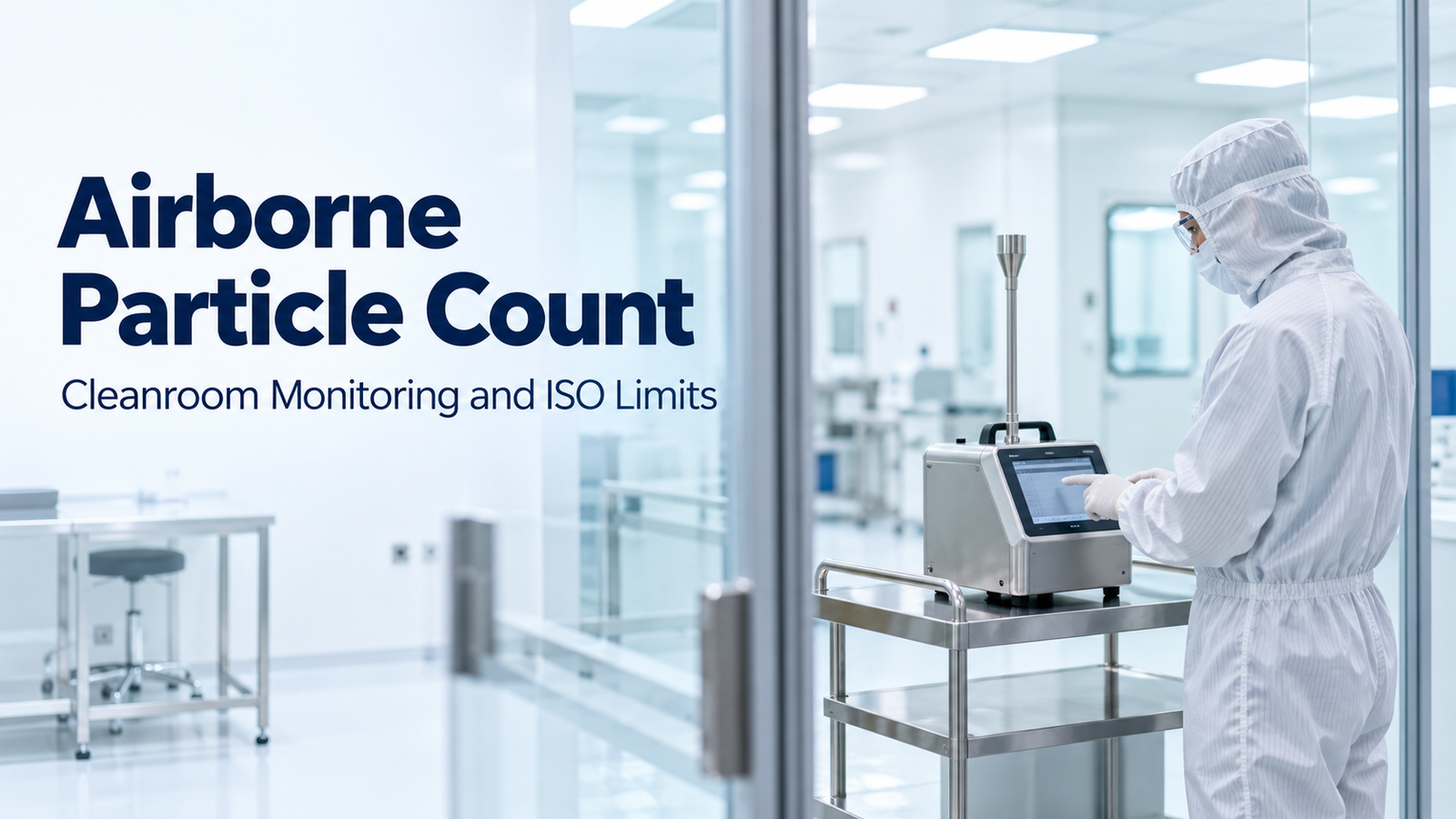
Airborne particle count monitoring is the ongoing tracking of how many particles are floating in a cleanroom’s air, so the room stays within its ISO 14644 limits day after day. Where a single test is a snapshot, airborne particle count monitoring watches the trend over time — catching a slow rise long before it becomes a failure.
This guide explains what airborne particle count monitoring is, how it differs from a one-off test, what the ISO limits mean, and how a monitoring programme is run.
Table of contents
- What is airborne particle count monitoring?
- Why monitoring the trend matters
- Understanding the ISO limits
- Method and instruments
- The monitoring process
- Standards and compliance
- FAQs
What is airborne particle count monitoring?
Airborne particle count monitoring is the routine or continuous measurement of airborne particle concentration in a controlled space, tracked against alert and action limits. It builds on the same measurement as a one-off particle count test, but its value is the record over time rather than a single result. It is a central part of a facility’s wider environmental monitoring programme.
Why monitoring the trend matters
- Catches drift early — a rising trend is seen before it breaches the limit.
- Shows real operation — monitoring captures how the room behaves in daily use.
- Guides action — alert limits prompt a check before an action limit is reached.
- Builds evidence — a documented history supports audits and investigations.
Understanding the ISO limits
Each ISO cleanliness class sets a maximum allowed concentration of airborne particles at defined sizes. A lower class number means fewer particles are permitted and a cleaner room. Monitoring compares the measured concentration with these limits and with the facility’s own alert and action levels, which are usually set tighter than the pass or fail limit so problems are caught early. The class a room must hold is its cleanroom classification.
Method and instruments
- Laser particle counters measure concentration by particle size.
- Fixed or portable sampling — critical areas may have continuous sampling; others are checked periodically.
- Defined sample points placed where contamination is most likely.
Because each reading may support a compliance record, calibrated, traceable instruments are essential.
The monitoring process
- Define the programme — agree points, sizes, frequency and alert and action limits.
- Verify instruments — confirm calibration and traceability.
- Sample and record — capture concentration at each point on schedule.
- Trend the data — watch the pattern against the limits over time.
- Act on excursions — investigate and correct any breach, and record the outcome.
Standards and compliance
- ISO 14644-1 and 14644-2 — classification and monitoring of air cleanliness (ISO 14644 overview).
- GMP — Good Manufacturing Practice for pharmaceutical environments.
- NABL / ISO/IEC 17025 — accreditation for the testing laboratory.
Monitoring vs one-off testing
A one-off particle count test proves a room passes on the day; monitoring proves it keeps passing. Both are needed: the test certifies the class, and monitoring shows the room holds that class through real, everyday operation. Read together, they give a complete picture of cleanliness.
How often should airborne particles be monitored?
Frequency depends on the class and risk. Critical sterile areas may be monitored continuously or at every session, while lower-risk rooms are checked on a periodic schedule set in the monitoring plan.
Common mistakes to avoid
- Only testing, never monitoring — a snapshot hides a slow drift.
- Poor point selection — sample where contamination is most likely.
- No alert limits — without them, problems are caught too late.
- Uncalibrated counters — results become indefensible.
Frequently asked questions
What is airborne particle count in simple terms?
It is the number of particles floating in a cleanroom’s air, tracked over time against the ISO limits for its class.
How is it different from a particle count test?
A test is a snapshot that certifies the class; monitoring tracks the trend to prove the room keeps meeting it.
What are alert and action limits?
Levels set tighter than the pass or fail limit, so a rising trend triggers a check before a real breach.
How is airborne particle count measured?
With calibrated laser particle counters at defined sample points, by particle size.
Do you provide NABL-accredited airborne particle monitoring?
Yes. Vanavil Calibrations carries out NABL-accredited airborne particle count testing on-site across Tamil Nadu.
Conclusion
Airborne particle count monitoring keeps a cleanroom trustworthy every day, not just on test day. By tracking particle concentration against ISO 14644 limits and acting on the trend, it protects products and patients — giving hospitals, pharmaceutical plants and laboratories continuous proof that their air stays clean.
Want dependable particle monitoring? Contact our team today. Vanavil Calibrations provides NABL-accredited airborne particle and clean room testing across Tamil Nadu with clear, audit-ready reports. Get in touch to plan your monitoring.