Noise Level Testing: Sound Measurement Methods and Standards
Noise level testing measures how loud a workplace, plant room or laboratory really is, so that people’s hearing is protected and the area stays within its noise limit. Because the ear is a poor judge of harmful sound, noise level testing uses a calibrated meter to turn noise into a measured value that can be compared with an occupational limit.
This guide explains what noise level testing involves, why it matters, the method and instruments, and the standards that apply.
Table of contents
- What is noise level testing?
- Why noise levels matter
- What it measures
- Instruments and method
- The testing process
- Standards and compliance
- FAQs
What is noise level testing?
Noise level testing is the measurement of sound pressure level, usually in A-weighted decibels, at the places where people work. It shows whether workers are exposed to harmful noise and whether an area meets its requirement. In controlled facilities it is often measured alongside lighting and other conditions covered by environmental monitoring.
Why noise levels matter
- Protects hearing — prolonged loud noise causes permanent hearing damage.
- Supports safety compliance — workplaces must control noise exposure.
- Improves communication — excessive noise makes instructions and alarms hard to hear.
- Flags equipment problems — rising noise can signal a failing machine or fan.
What noise level testing measures
- Sound pressure level — the loudness at each operator position.
- Exposure over time — how noise varies across a working period.
- Area mapping — how noise changes from point to point.
- Comparison with the limit — against the applicable occupational noise limit.
Only the noise limit that genuinely applies to a workplace is used — no invented figures.
Instruments and method
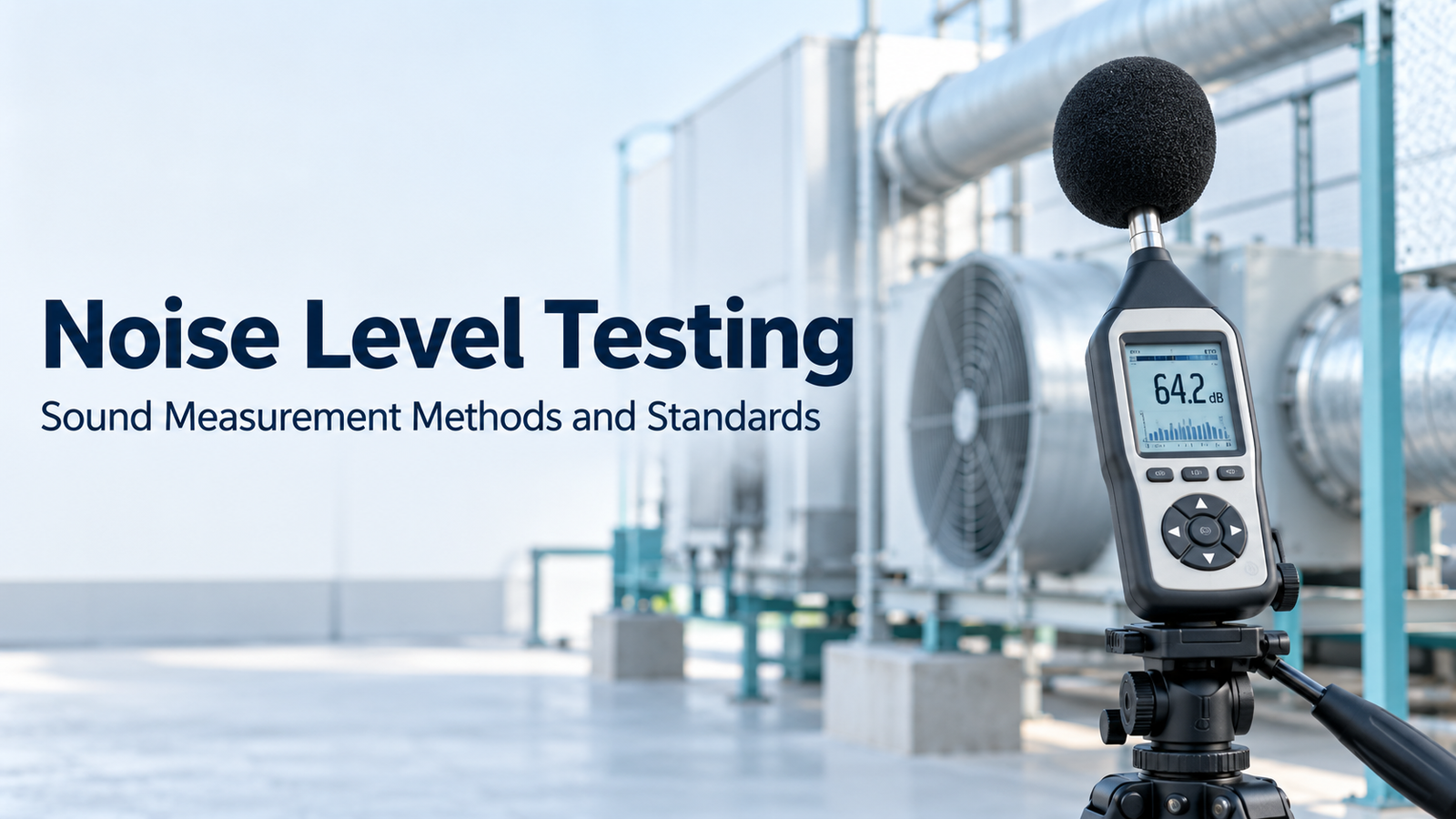
- Calibrated sound level meters measure the noise at each position.
- An acoustic calibrator checks the meter before and after measurement.
- Defined measurement points at operator positions and around noisy equipment.
Because each reading may support a safety record, calibrated, traceable instruments are essential.
The noise level testing process
- Define the scope — agree the positions, duration and applicable limit.
- Verify the meter — check it with a calibrator and confirm traceability.
- Measure at each point — record noise at operator positions and near equipment.
- Assess exposure — compare the readings with the noise limit.
- Report — document the values and a pass or fail against the requirement.
Standards and compliance
- Occupational noise guidance — the noise-exposure requirements that apply to the workplace (sound level meter).
- Workplace safety regulations — hearing-protection and control requirements.
- NABL / ISO/IEC 17025 — accreditation for the testing laboratory.
Noise as part of a safe environment
Noise sits alongside lighting, air and temperature as a condition that affects the people in a space. Measuring it belongs with the wider workplace checks that include lux level measurement and routine performance testing of the facility.
How often should noise levels be tested?
Many facilities test noise when equipment or layout changes, and then periodically, because worn machinery and new processes can push levels up over time.
Common mistakes to avoid
- Not calibrating on site — the meter should be checked before and after.
- Measuring away from the operator — readings must reflect the exposure.
- Ignoring peaks — short, loud events matter as well as averages.
- Uncalibrated meters — results become indefensible.
Frequently asked questions
What is noise level testing in simple terms?
It is using a calibrated meter to measure how loud a workplace is and comparing it with the noise limit.
Why is workplace noise measured?
To protect workers from hearing damage and to confirm the area meets its noise requirement.
What instrument is used?
A calibrated sound level meter, checked with an acoustic calibrator and traceable to reference standards.
Where is noise measured?
At operator positions and around noisy equipment, where people are actually exposed.
Do you provide NABL-accredited noise level testing?
Yes. Vanavil Calibrations carries out NABL-accredited noise level testing on-site across Tamil Nadu.
Conclusion
Noise level testing turns loudness into a measured value that protects people. By measuring sound at operator positions against the applicable limit, it safeguards hearing, supports safety compliance and gives workplaces and laboratories documented proof that their noise is under control.
Need your noise levels checked? Contact our team today. Vanavil Calibrations provides NABL-accredited noise level testing and clean room testing across Tamil Nadu with clear, audit-ready reports. Get in touch to schedule your testing.