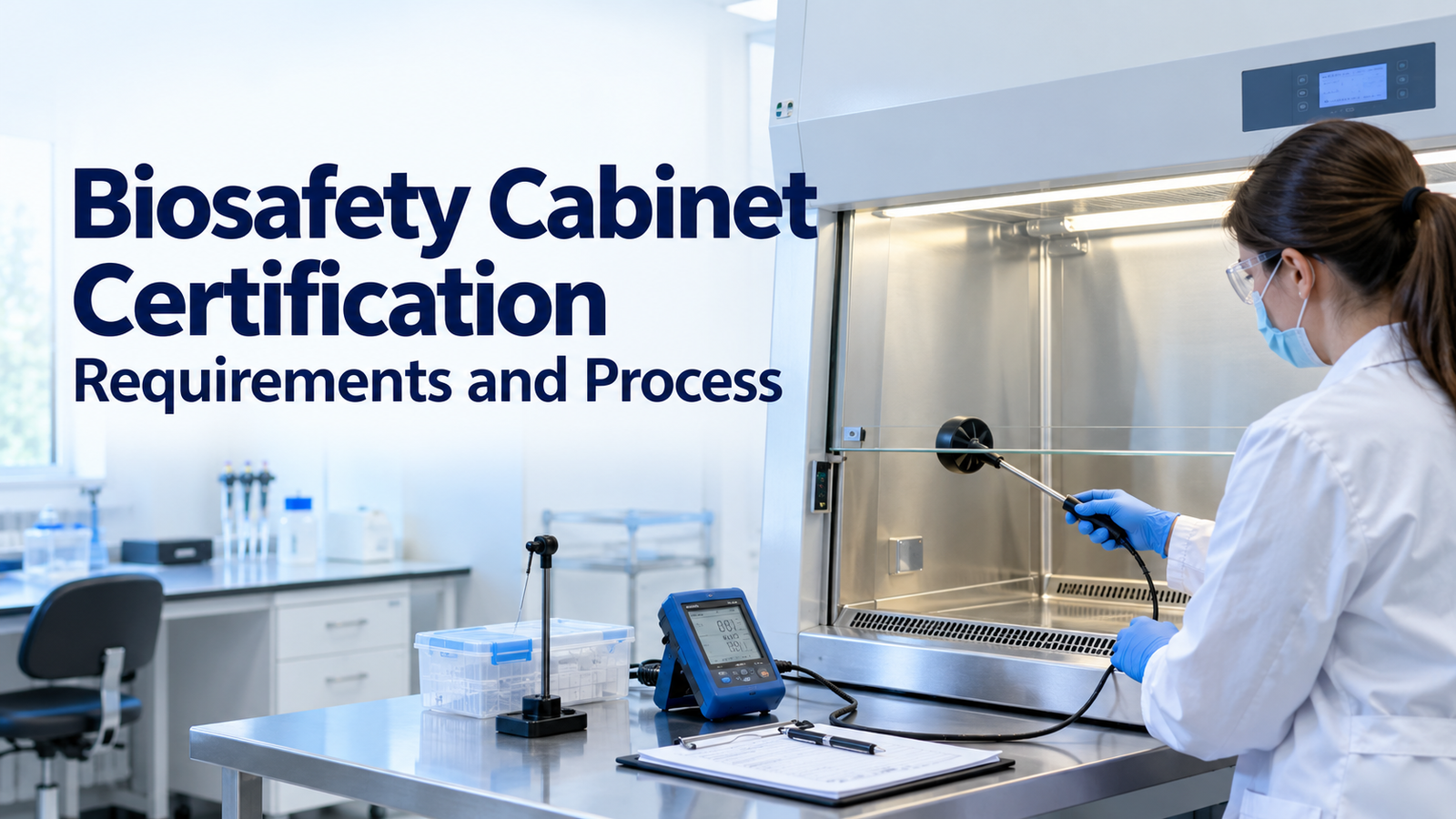
Biosafety Cabinet Certification: Requirements and Process
Biosafety cabinet certification is the formal, documented confirmation that a biosafety cabinet has passed its performance tests and is safe to use. A cabinet may be tested, but it is the certificate that your auditors, biosafety officers and customers actually ask to see — so biosafety cabinet certification turns a set of measurements into recognised, audit-ready proof of containment.
This guide explains what biosafety cabinet certification covers, when it is needed, what the certificate states, and the standards behind it.
Table of contents
- What is biosafety cabinet certification?
- Why certification matters
- What certification covers
- When certification is needed
- What the certificate states
- Standards and compliance
- FAQs
What is biosafety cabinet certification?
Biosafety cabinet certification is the process of testing a cabinet against its standard and issuing an accredited certificate that records the result. It draws on the full biosafety cabinet testing process — airflow, filter integrity and containment — but the emphasis is on producing a defensible certificate that proves the cabinet protects the operator, product and environment.
Why biosafety cabinet certification matters
- Recognised proof — a certificate is what auditors and biosafety officers accept.
- Safety assurance — it confirms containment is genuinely in place.
- Compliance — many laboratories must hold current certification for their cabinets.
- Traceability — an accredited certificate ties results to reference standards.
What biosafety cabinet certification covers
Certification is based on the cabinet passing its key tests:
- Inflow velocity — the air drawn in for operator protection.
- Downflow velocity — the clean air over the work surface.
- HEPA filter integrity — no leaks in the supply and exhaust filters.
- Airflow pattern — correct air direction at the window and work zone.
Only the criteria that genuinely apply to the cabinet’s class and standard are used — no invented limits. The filter checks follow the same principles as a HEPA filter integrity test.
When biosafety cabinet certification is needed
- At installation — before a new cabinet is put into use.
- Annually — most cabinets are recertified at least once a year.
- After a move — relocation can disturb the airflow.
- After a filter change or repair — any work that could affect performance.
What the certificate states
A biosafety cabinet certificate records the cabinet and its class, the tests performed, the measured values, a pass or fail against each limit, and the certification date. Clear documentation is what makes the certificate defensible, and it is a key difference between one certification provider and another — the same principle behind good clean room certification.
Standards and compliance
- Recognised BSC standards — such as NSF/ANSI 49 and EN 12469, applied where they genuinely fit.
- ISO 14644 — clean-air device test methods (ISO 14644 overview).
- NABL / ISO/IEC 17025 — accreditation for the testing laboratory.
Certification and testing together
Testing produces the measurements; certification issues the accredited record based on them. A cabinet cannot be certified without passing its tests, and the tests are only fully useful once they are documented in a certificate — which is why the two go hand in hand.
How long is certification valid?
Validity is usually up to a year, after which the cabinet must be retested and recertified. A certificate also lapses in practice if the cabinet is moved or has filter work, which is why prompt recertification matters.
Frequently asked questions
What is biosafety cabinet certification in simple terms?
It is the accredited certificate confirming a cabinet has passed its airflow and filter tests and provides real containment.
What does the certificate cover?
Inflow and downflow velocities, HEPA filter integrity and the airflow pattern, with a pass or fail and the date.
When must a cabinet be certified?
At installation, at least annually, and again after any move, filter change or repair.
Is certification the same as testing?
Testing provides the measurements; certification issues the accredited record based on those results.
Do you provide NABL-accredited biosafety cabinet certification?
Yes. Vanavil Calibrations carries out NABL-accredited biosafety cabinet testing and certification on-site across Tamil Nadu.
Conclusion
Biosafety cabinet certification turns cabinet performance into recognised, documented proof. By testing airflow, filtration and containment against recognised standards and issuing a defensible certificate, it keeps laboratories and hospitals safe, compliant and confident that their cabinets genuinely protect people, product and the environment.
Need your cabinets certified? Contact our team today. Vanavil Calibrations provides NABL-accredited biosafety cabinet certification and clean room testing across Tamil Nadu with clear, audit-ready reports. Get in touch to schedule certification.