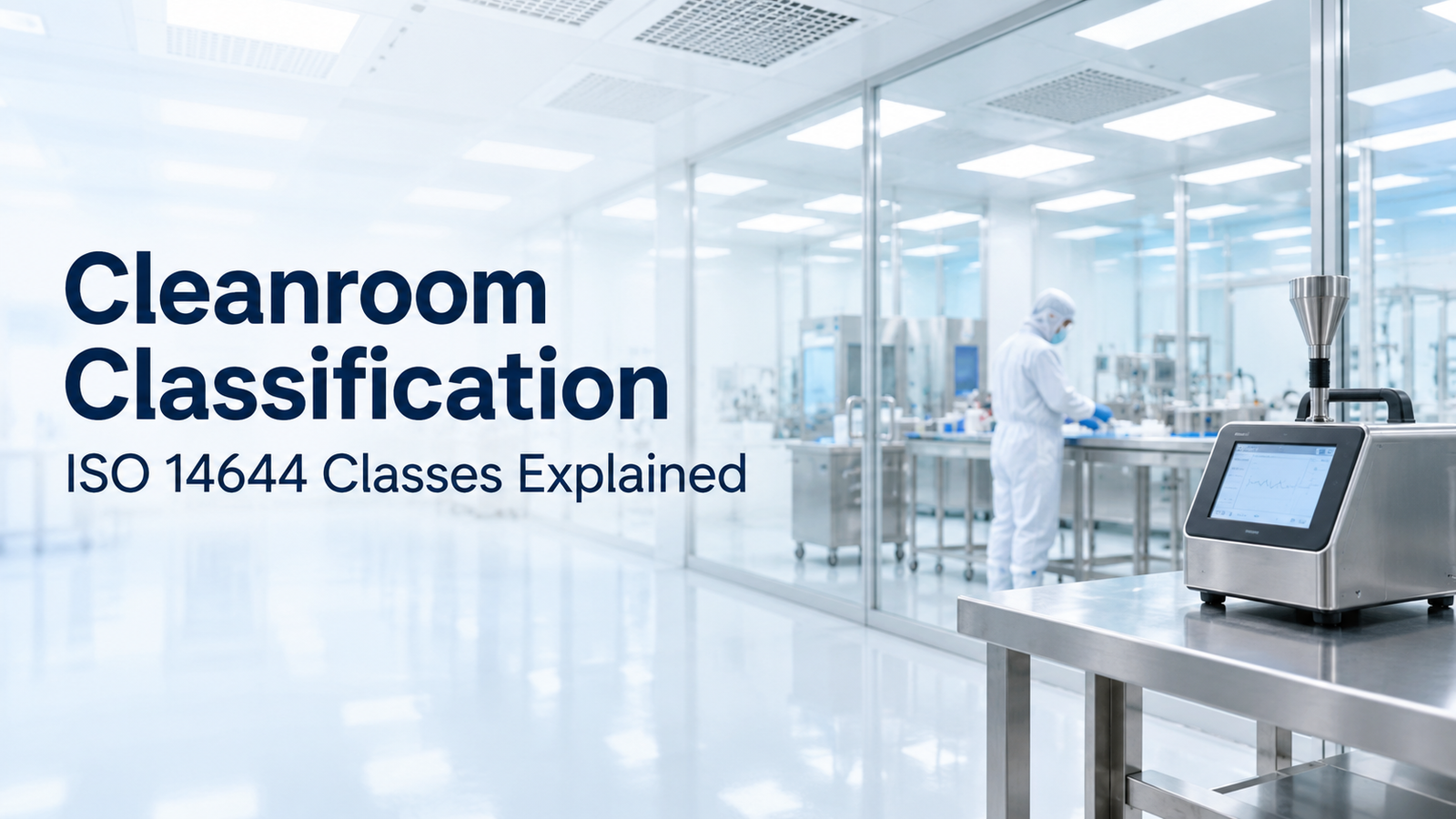
Cleanroom Classification: ISO 14644 Classes Explained
Cleanroom classification is the grading system that says how clean a controlled room actually has to be, based on the number of airborne particles its air is allowed to contain. Under ISO 14644, cleanroom classification runs from the ultra-clean ISO Class 1 to the much less strict ISO Class 9, and knowing your class is the starting point for every test, certificate and monitoring plan.
This guide explains what cleanroom classification means, how the ISO 14644 classes work, how a class is assigned, and where each level is typically used.
Table of contents
- What is cleanroom classification?
- The ISO 14644 classes
- How a class is assigned
- Occupancy states
- Where each class is used
- Standards and compliance
- FAQs
What is cleanroom classification?
Cleanroom classification is the assignment of an ISO class to a room according to the maximum concentration of airborne particles it may contain at defined particle sizes. A lower class number means fewer particles are allowed and a cleaner room. The class sets the target that a particle count test is measured against, and it drives the whole approach to clean room performance testing.
The ISO 14644 classes
ISO 14644-1 defines nine classes, from ISO Class 1 to ISO Class 9:
- ISO Class 1 to 3 — the cleanest environments, used for the most sensitive work such as semiconductor and nanotechnology processes.
- ISO Class 4 to 6 — very clean rooms for critical pharmaceutical, medical device and precision work.
- ISO Class 7 to 8 — common in pharmaceutical support areas, hospitals and manufacturing.
- ISO Class 9 — the least strict classified level, still cleaner than ordinary room air.
Each class caps the number of particles per cubic metre at specified sizes. Only the class that genuinely applies to a facility is used — no invented limits.
How a cleanroom class is assigned
A class is confirmed by measuring airborne particles at enough sample points to represent the whole room, then comparing the results with the limits for the target class. The number of sample points depends on the room area, and the measurement follows a defined method so results are repeatable. If every point is within the limit, the room meets the class.
Occupancy states
Classification is stated for a specific occupancy state, because particle levels change with activity:
- As-built — the room complete but empty of equipment and people.
- At-rest — equipment installed and running, no people working.
- Operational — the room in full use, with people and processes active.
A room may hold one class at rest and a different one in operation, so the state is always recorded with the class.
Where each class is used
- Sterile pharmaceutical filling — typically the cleaner classes for the critical zone.
- Medical device manufacturing — mid-range classes for controlled assembly.
- Hospitals and healthcare — classified areas for operating theatres and sterile stores.
- Electronics and research — from mid-range to the very cleanest classes.
The right class depends on the process and its risk, agreed with the facility rather than assumed.
Standards and compliance
- ISO 14644-1 — classification of air cleanliness by particle concentration (ISO 14644 overview).
- GMP — Good Manufacturing Practice, which maps its own grades onto controlled environments.
- NABL / ISO/IEC 17025 — accreditation for the testing laboratory.
Classification and validation
Classification defines the target; proving a room holds that target over time is the job of ISO 14644 validation. The two work together: the class says how clean the room must be, and validation confirms it stays that clean in real use.
Common questions about classification
- Lower is cleaner — ISO Class 1 is far stricter than ISO Class 9.
- Class is per state — always recorded with the occupancy condition.
- Class needs proof — it is confirmed by measurement, not by design alone.
Frequently asked questions
What is cleanroom classification in simple terms?
It is the ISO grade that says how many airborne particles a room may contain — the lower the class number, the cleaner the room.
How many ISO cleanroom classes are there?
Nine, from ISO Class 1 (cleanest) to ISO Class 9, defined in ISO 14644-1.
How is a cleanroom class confirmed?
By measuring airborne particles at defined points and comparing them with the limits for the target class.
Does the class depend on occupancy?
Yes. A room can hold different classes as-built, at-rest and operational, so the state is always stated.
Do you provide NABL-accredited cleanroom classification testing?
Yes. Vanavil Calibrations carries out NABL-accredited classification testing on-site across Tamil Nadu.
Conclusion
Cleanroom classification is the foundation that every other cleanroom activity is built on. By grading a room from ISO Class 1 to ISO Class 9 according to its airborne particle limits, it sets the target for testing, certification and monitoring — and gives hospitals, pharmaceutical plants and laboratories a clear, measurable definition of clean.
Need your cleanroom classified? Contact our team today. Vanavil Calibrations provides NABL-accredited classification and clean room testing across Tamil Nadu with clear, audit-ready reports. Get in touch to confirm your class.