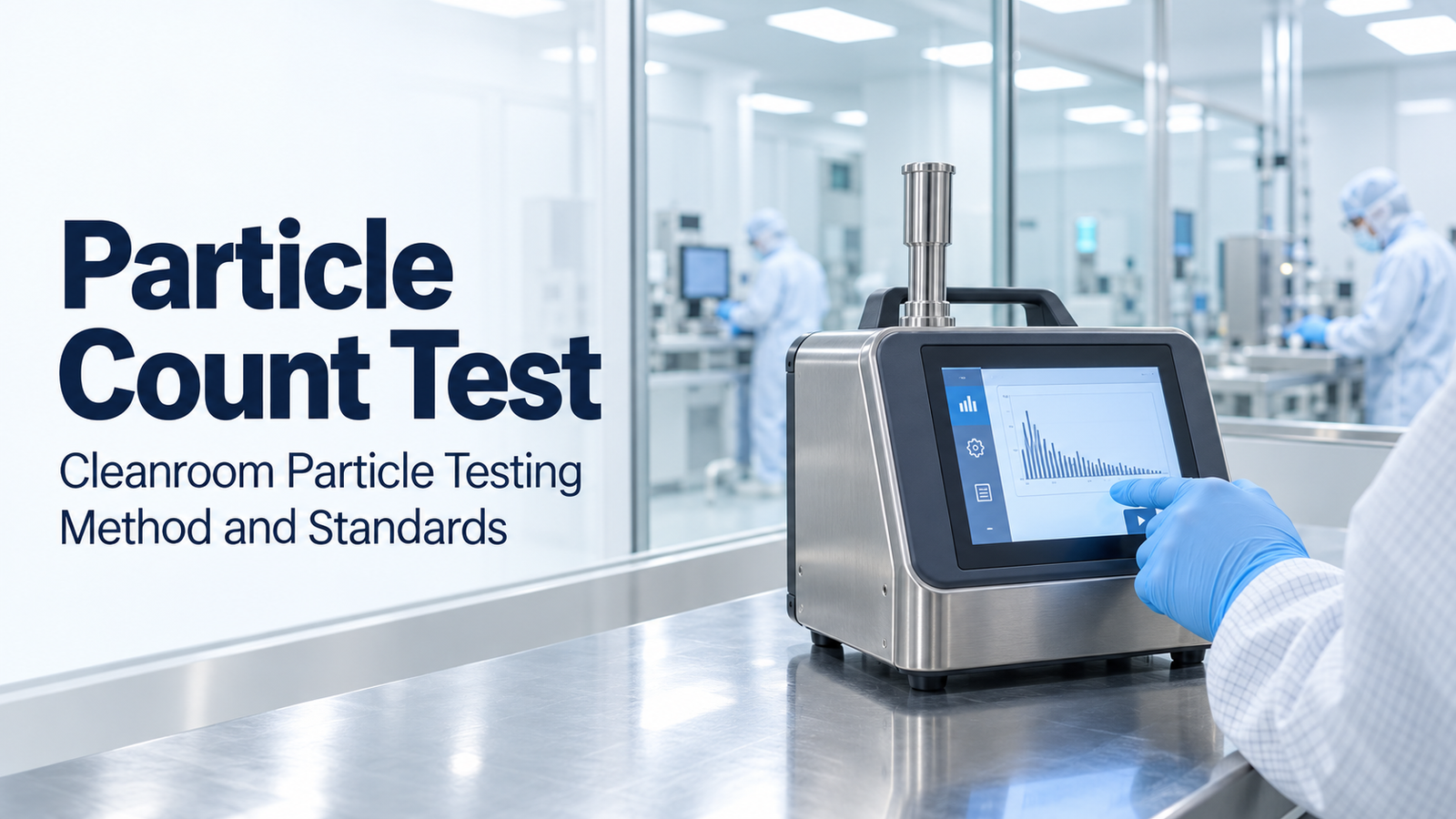
Particle Count Test: Cleanroom Particle Testing Method and Standards
A particle count test measures the number and size of airborne particles in a cleanroom and compares them with the room’s ISO 14644 cleanliness class. It is the single most direct check of whether a controlled space is actually clean, which is why the particle count test sits at the heart of almost every cleanroom certification and routine test.
This guide explains what a particle count test involves, why it matters, the method and instruments, the occupancy states, and the standards that apply.
Table of contents
- What is a particle count test?
- Why particle counting matters
- What it measures
- Method and instruments
- Occupancy states
- Standards and compliance
- FAQs
What is a particle count test?
A particle count test is the on-site measurement of airborne particle concentration at defined sample points, sorted by particle size. The results are compared with the limits for the room’s ISO class to decide a pass or fail. It is the core measurement behind clean room performance testing and the number that most directly reflects a room’s cleanroom classification.
Why particle counting matters
- Defines the class — the particle count is what an ISO class is based on.
- Protects the product — airborne particles carry contamination onto sensitive work.
- Confirms filtration — low counts show HEPA filters and airflow are working.
- Supports compliance — auditors expect current particle-count evidence.
What a particle count test measures
- Particle concentration — the number of particles per cubic metre of air.
- Particle size — counts at defined sizes such as 0.5 micron and larger.
- Sample locations — enough points to represent the whole room.
- Comparison with the class limit — a pass or fail at each point.
Only the class and limits that genuinely apply to a facility are used — no invented figures.
Method and instruments
- Laser (optical) particle counters draw a measured volume of air and count particles by size.
- A sampling plan sets the number and position of points based on the room area.
- Defined sample volumes and times ensure results are comparable and repeatable.
Because each reading supports a compliance record, calibrated, traceable instruments are essential. Particle results are read alongside airborne particle count monitoring to see both the snapshot and the trend.
Occupancy states
A particle count test is carried out in a defined occupancy state, because results differ depending on activity:
- As-built — the room complete but with no equipment or people.
- At-rest — equipment installed and running, but no people working.
- Operational — the room in full use, with people and processes active.
The state is agreed in advance so the result can be compared fairly with the requirement.
Standards and compliance
- ISO 14644-1 — classification of air cleanliness by particle concentration (ISO 14644 overview).
- GMP — Good Manufacturing Practice for pharmaceutical environments.
- NABL / ISO/IEC 17025 — accreditation for the testing laboratory.
The testing process
- Define the scope — agree the room, class, occupancy state and sample points.
- Verify instruments — confirm calibration and traceability.
- Sample each point — draw the set air volume and record counts by size.
- Compare with limits — assess each point against the class requirement.
- Report — document the counts and a pass or fail for the room.
How often should a particle count test be done?
Many facilities run a particle count test every 6 to 12 months, with more critical rooms tested more often, as part of their wider clean room testing schedule.
Common mistakes to avoid
- Too few sample points — the plan must represent the whole room.
- Wrong occupancy state — results must match the agreed condition.
- Uncalibrated counters — results become indefensible.
- Ignoring larger particles — both small and large sizes matter.
Frequently asked questions
What is a particle count test in simple terms?
It is measuring how many airborne particles of each size are in a cleanroom and comparing them with the ISO class limit.
What instrument is used?
A calibrated laser particle counter that draws a set volume of air and counts particles by size.
What are as-built, at-rest and operational states?
They are the three occupancy conditions a room can be tested in, from empty to fully in use.
How many sample points are needed?
The number depends on the room area and is set by the sampling plan so the result represents the whole space.
Do you provide NABL-accredited particle count testing?
Yes. Vanavil Calibrations carries out NABL-accredited particle count testing on-site across Tamil Nadu.
Conclusion
A particle count test is the clearest proof that a cleanroom is genuinely clean. By measuring airborne particles by size at defined points against ISO 14644-1, it confirms a room meets its class — keeping cleanrooms in hospitals, pharmaceutical plants and laboratories safe, compliant and inspection-ready.
Need your particle counts verified? Contact our team today. Vanavil Calibrations provides NABL-accredited particle count and clean room testing across Tamil Nadu with clear, audit-ready reports. Get in touch to schedule your testing.
2 Comments