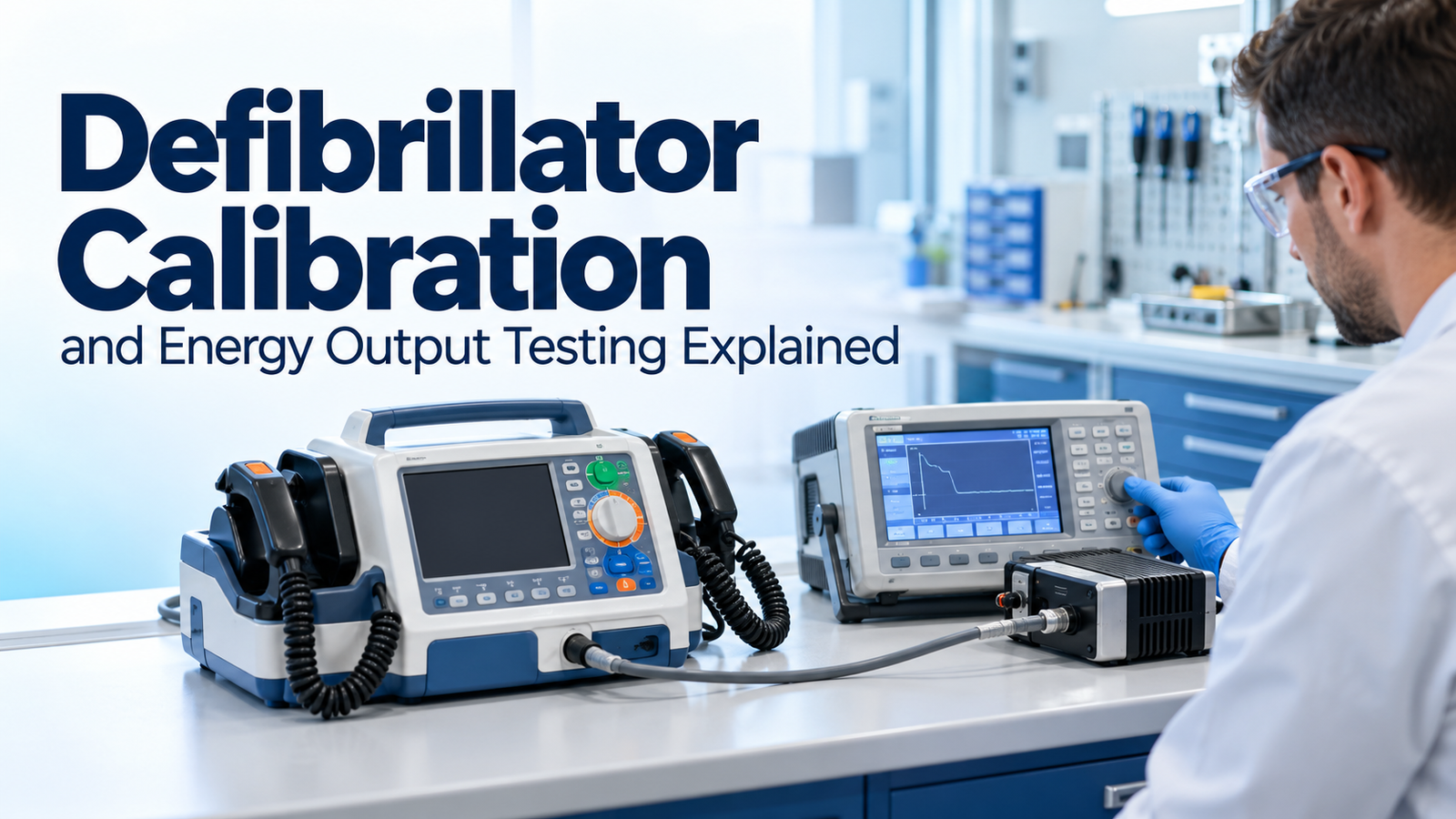
Defibrillator Calibration and Energy Output Testing Explained
When a defibrillator is needed, there is no time to wonder whether it will deliver the energy selected. Defibrillator calibration checks exactly that: that the device charges quickly, delivers the energy shown on its dial and synchronises correctly when used for cardioversion. It is one of the most important checks on any hospital’s calibration list.
Table of contents
- What defibrillator calibration covers
- Energy output testing
- Other checks
- AEDs in public and ward areas
- How often to test
- Defibrillator readiness checklist for wards
- Biphasic and monophasic defibrillators
- A worked example: calibrating a ward defibrillator
- Common problems found in defibrillators
- Preparing for the calibration visit
- Frequently asked questions
What defibrillator calibration covers
A defibrillator stores electrical energy in a capacitor and releases it through the patient’s chest. Over time, capacitors, batteries and internal circuits age. The device may still charge and fire, but deliver less energy than selected, or take longer to charge. Calibration uses a defibrillator analyser, a traceable instrument that absorbs the shock through a test load and measures what was actually delivered.
Energy output testing
Energy is measured at several selected levels across the device’s range. Each measured value is compared with the selected energy and the manufacturer’s tolerance. For biphasic defibrillators, the analyser also records the waveform so the engineer can confirm it behaves as specified.
- Delivered energy at low, medium and maximum settings
- Waveform shape for biphasic devices
- Consistency across repeated discharges
Other checks
- Charge time — how long the device takes to reach maximum energy, including on battery
- Synchronised cardioversion — the shock is timed correctly to the R wave
- ECG monitoring — heart rate display and alarms using a simulated signal
- Pacing — pacing rate and current, where the device supports it
- Internal discharge — stored energy is safely dumped when a shock is cancelled
- Battery condition and paddles or pads for damage
Together these checks show whether the defibrillator will perform when it matters. Results are recorded on a certificate with measurement uncertainty and pass/fail status.
AEDs in public and ward areas
Automated external defibrillators are often placed in corridors, outpatient areas and ambulances. Because they are used rarely, faults can go unnoticed. Include every AED in your register, check pads and batteries for expiry, and calibrate them alongside ward defibrillators.
How often to test
Most hospitals calibrate defibrillators at least once a year and after any repair. Daily or shift-wise user checks, often including a test discharge into the device’s own test load, remain important but do not replace independent calibration with a traceable analyser. Read our guide to medical device calibration for help setting intervals.
Defibrillator readiness checklist for wards
Calibration is annual, but readiness is daily. A short checklist, kept with each defibrillator, helps staff spot problems between calibrations:
- Power: the device is plugged in or the battery indicator shows enough charge.
- Self-test: the daily or shift self-test has passed and is signed off.
- Pads and paddles: pads are in date and sealed; paddles are clean and undamaged.
- Cables: ECG and therapy cables show no cracks, kinks or exposed wires.
- Consumables: ECG electrodes, gel, razor and recording paper are stocked.
- Calibration label: the next due date is visible and has not passed.
If any item fails, the device should be reported to the biomedical team straight away. Record which defibrillators failed checks during the year; units with repeated faults are good candidates for shorter calibration intervals or replacement. Keeping defibrillator records together with other hospital critical care equipment makes audits much simpler.
Biphasic and monophasic defibrillators
Most defibrillators in service today use a biphasic waveform, where current flows in one direction and then reverses. Some older units use a monophasic waveform. The difference matters for testing because biphasic devices often adjust delivered energy based on the patient’s impedance. A good defibrillator analyser can present different load resistances so the engineer can confirm the device compensates as the manufacturer intends.
When you register defibrillators, record the waveform type and maximum energy. This helps the provider choose the right test loads and makes it easier to compare results over time. If your hospital still uses monophasic units, calibration remains important, but their age may also make them candidates for planned replacement.
A worked example: calibrating a ward defibrillator
- Inspection. Check the case, display, paddles or pads connector, therapy cable, ECG cable and battery. Confirm pads are in date.
- ECG monitoring. Connect ECG leads to the analyser’s simulator and check heart rate display and alarm response.
- Charge time. Charge to maximum energy on battery and on mains, recording how long each takes.
- Energy output. Discharge at several energy settings into the analyser and compare delivered energy with the selected value.
- Synchronised mode. Enable synchronisation and confirm the shock is delivered correctly relative to the simulated R wave.
- Pacing where available: check pacing rate and output current.
- Internal discharge. Charge, cancel and confirm the stored energy is safely dumped.
- Documentation. Record results with measurement uncertainty and label the unit with its next due date.
Common problems found in defibrillators
- Weak batteries causing slow charge times or failure to charge on battery power.
- Expired or dried-out pads kept with the device.
- Damaged therapy cables with cracked insulation near connectors.
- Delivered energy drifting below the selected value in older units.
- Missed daily checks on units in low-use areas.
Battery management causes more defibrillator failures than any other single factor. Recording battery installation dates and replacing them on the manufacturer’s schedule prevents most charge-time problems.
Preparing for the calibration visit
A little preparation makes defibrillator calibration faster and avoids repeat visits. Before the provider arrives, collect the list of defibrillators and AEDs with their locations, and confirm which units can be released and when. Charge batteries fully so charge-time tests reflect normal performance. Replace any pads that are close to expiry, and have spare therapy cables available in case a damaged cable is found. Arrange a replacement unit for each area during testing so no ward is left without a working defibrillator.
After the visit, check that every unit has returned to its correct location, that labels show the new due date and that any failed units are clearly marked out of service until repaired.

Frequently asked questions
Is the defibrillator’s built-in self-test enough?
No. The self-test uses the device’s own circuits. Independent calibration measures delivered energy with a separate, traceable analyser.
Can defibrillators be tested on the ward?
Yes. The analyser is portable, so defibrillators are usually tested on-site, one at a time, with a replacement available during testing.
What happens if delivered energy is outside tolerance?
The device should be taken out of use and repaired, then re-tested before returning to service. The failure is recorded on the certificate.
Do you calibrate AEDs?
Yes. AEDs are tested for delivered energy and function in the same way, along with checks of pads and batteries.
Should training defibrillators be calibrated?
Training units that cannot deliver a real shock do not need energy calibration, but they should be clearly labelled so they are never mistaken for clinical devices.
How are AEDs in ambulances handled?
Ambulance AEDs and defibrillators should be on the same register and schedule, with extra attention to battery condition because of vibration and temperature changes.
Conclusion
Defibrillator calibration gives clinical teams confidence that the device will deliver the energy they select, charge quickly and synchronise correctly. It is simple to plan and vital to get right.
External reference: NABL India.
Need defibrillators calibrated? Vanavil Calibrations provides on-site medical equipment calibration across Tamil Nadu. Contact our team.