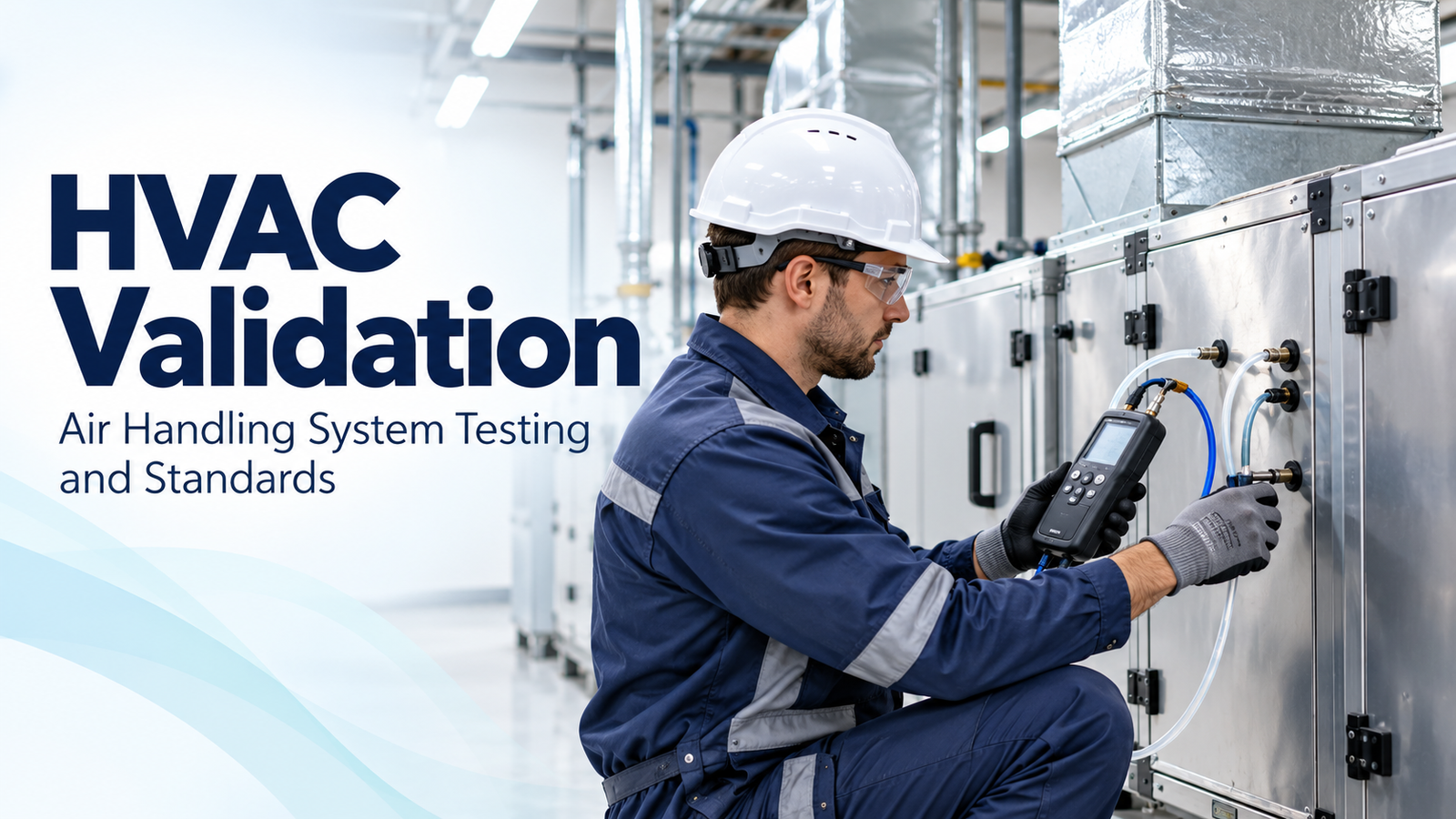
HVAC Validation: Air Handling System Testing and Standards
HVAC validation is the testing that proves the heating, ventilation and air-conditioning system behind a cleanroom or hospital is actually controlling the environment it serves. The HVAC system is the engine of every controlled space, so HVAC validation checks that its airflow, filtration, pressure and conditioning all perform to design — because if the system drifts, every room it feeds drifts with it.
This guide explains what HVAC validation involves, why it matters, the parameters tested, the process, and the standards that apply.
Table of contents
- What is HVAC validation?
- Why HVAC validation matters
- What is tested
- Methods and instruments
- The validation process
- Standards and compliance
- FAQs
What is HVAC validation?
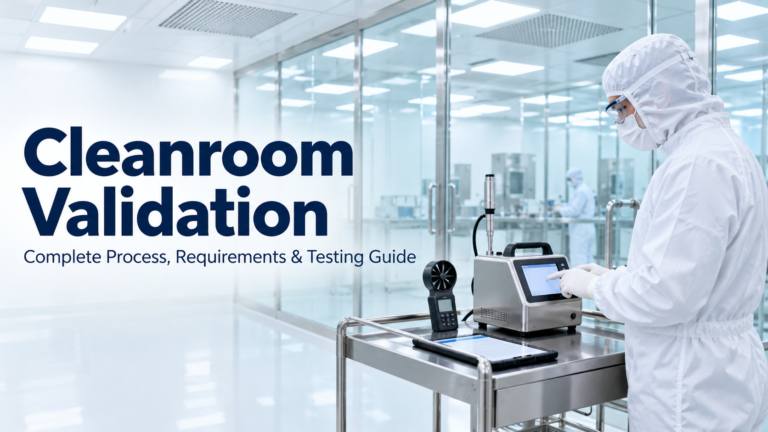
HVAC validation is the documented testing of an air-handling system to confirm it delivers the air volume, cleanliness, pressure and conditions the connected rooms require. It looks at the system as a whole — the air-handling units, ducts, filters and controls — and how it performs at the rooms it serves. It underpins broader cleanroom validation, because a room can only stay in control if the HVAC feeding it stays in control.
Why HVAC validation matters
- Controls every connected room — the HVAC sets the air for all the spaces it feeds.
- Maintains cleanliness — filtration and air changes keep particles under control.
- Holds the pressure cascade — the system keeps clean rooms positive to dirty ones.
- Supports compliance — auditors expect the air-handling system to be validated.
What HVAC validation tests
HVAC validation typically covers:
- Air volumes and air changes — enough supply to each room, giving the required air changes per hour.
- HEPA filter integrity — no leaks in the terminal filters.
- Differential pressure — the correct cascade between rooms.
- Temperature and humidity control — conditions held within specification.
- Filter condition — pressure drop across filters within limits.
- Fresh-air and recirculation — the right balance for the application.
Only the criteria that genuinely apply to a facility are used — no invented limits.
Methods and instruments
- Balometers and anemometers measure air volumes and velocities.
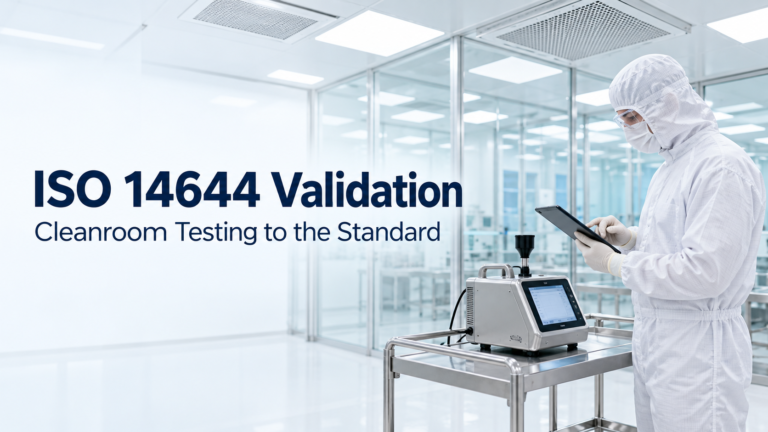
- Aerosol photometers scan HEPA filters for leaks.
- Micro-manometers confirm room-to-room pressure differences.
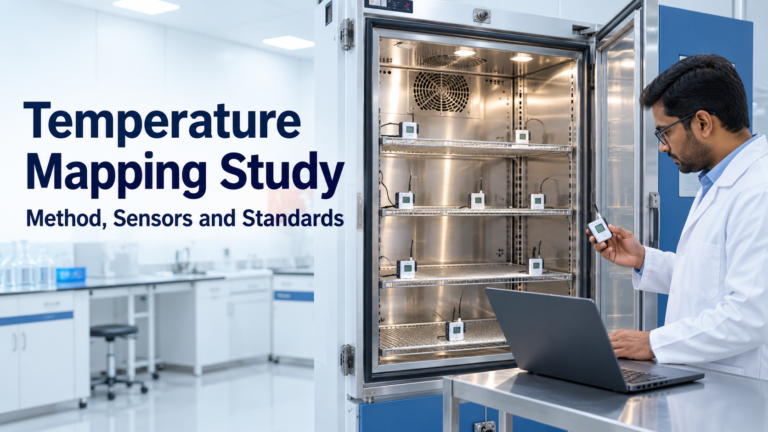
- Calibrated sensors verify temperature and humidity control.
Because each reading supports a compliance record, calibrated, traceable instruments are essential. Pressure results tie directly to differential pressure testing.
The HVAC validation process
- Define the scope — agree the system, rooms, parameters and acceptance criteria.
- Verify instruments — confirm calibration and traceability.
- Measure performance — air volumes, filters, pressure and conditions at each point.
- Compare with design — assess each result against the requirement.
- Report — document a pass or fail with corrective actions if needed.
Standards and compliance
- ISO 14644 — cleanroom air cleanliness and test methods (ISO 14644 overview).
- GMP — Good Manufacturing Practice for pharmaceutical environments.
- NABL / ISO/IEC 17025 — accreditation for the testing laboratory.
HVAC validation and the rooms it serves
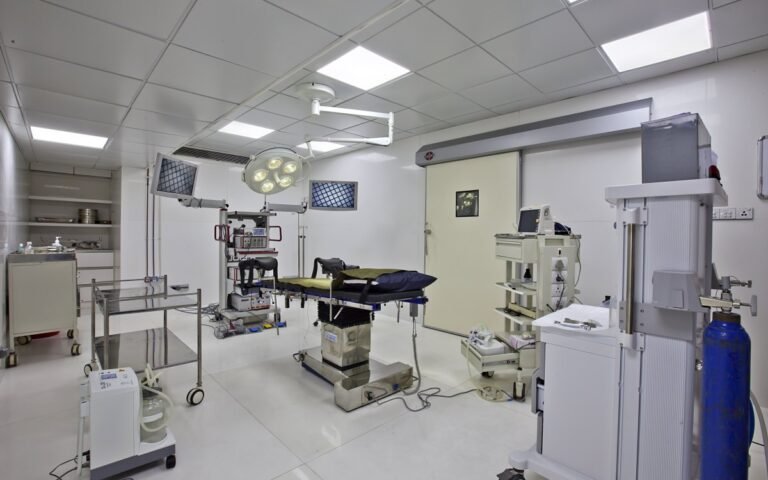
Validating the HVAC and validating the rooms are two halves of one picture. The system provides the clean, conditioned, pressurised air; the rooms prove they hold it. That is why HVAC validation is carried out alongside the testing of critical spaces such as operating theatres and cleanrooms.
How often should HVAC be validated?
Many facilities validate the HVAC when it is installed or modified, and then requalify periodically, with routine checks in between and extra testing after any major service or filter change.
Common mistakes to avoid
- Testing rooms but not the system — the HVAC drives every room.
- Ignoring filter pressure drop — a loading filter changes the airflow.
- Skipping the pressure cascade — the whole layout depends on it.
- Uncalibrated instruments — results become indefensible.
Frequently asked questions
What is HVAC validation in simple terms?
It is testing the air-handling system to prove it delivers the clean, conditioned, pressurised air that its cleanrooms and theatres need.
What does HVAC validation test?
Air volumes and air changes, HEPA filter integrity, differential pressure, temperature and humidity control and filter condition.
Why validate the HVAC and not just the rooms?
Because the HVAC controls every room it feeds; if the system drifts, the rooms drift with it.
How often should HVAC be validated?
At installation or modification, then requalified periodically with routine checks in between.
Do you provide NABL-accredited HVAC validation?
Yes. Vanavil Calibrations carries out NABL-accredited HVAC validation on-site across Tamil Nadu.
Conclusion
HVAC validation proves the engine behind every controlled space is working. By testing air volumes, filtration, pressure and conditioning against recognised standards, it keeps cleanrooms and theatres in control — giving hospitals, pharmaceutical plants and laboratories documented proof that their air-handling system performs as designed.
Need your HVAC validated? Contact our team today. Vanavil Calibrations provides NABL-accredited HVAC and clean room testing across Tamil Nadu with clear, audit-ready reports. Get in touch to schedule your validation.