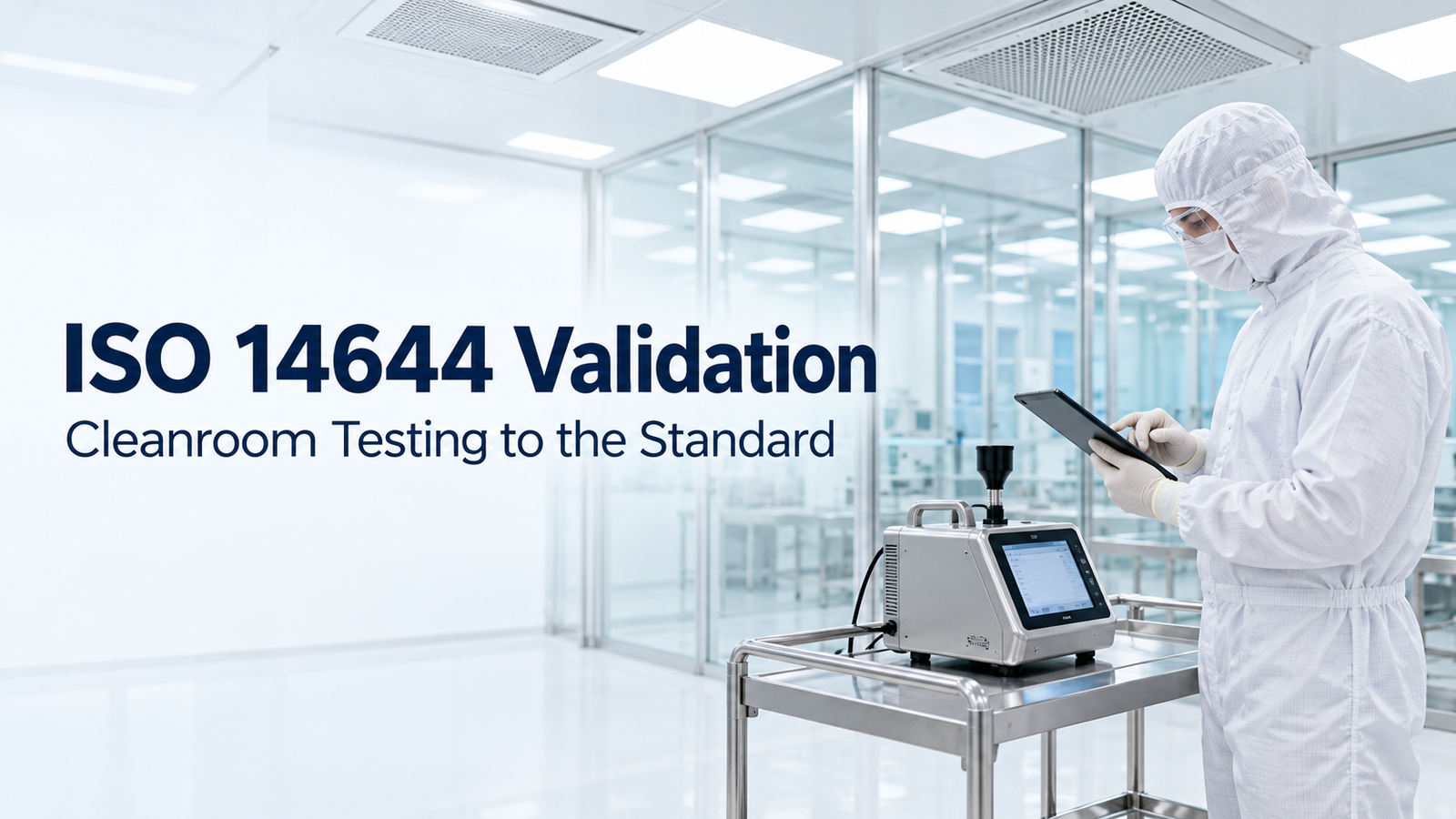
ISO 14644 Validation: Cleanroom Testing to the Standard
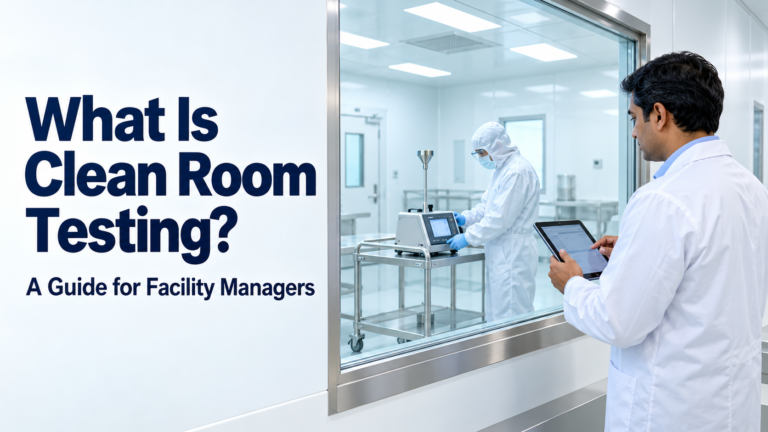
ISO 14644 validation is the testing that proves a cleanroom meets the international standard for controlled environments — and keeps meeting it in real use. ISO 14644 is the reference the whole cleanroom industry works to, so ISO 14644 validation measures a room’s particles, airflow, pressure and filtration against the standard’s methods and limits, turning “built to the standard” into proven, documented compliance.
This guide explains what ISO 14644 validation involves, the parts of the standard, the tests, the process, and how validation relates to classification.
Table of contents
- What is ISO 14644 validation?
- The parts of ISO 14644
- What is tested
- The validation process
- Validation and classification
- Standards and compliance
- FAQs
What is ISO 14644 validation?
ISO 14644 validation is the structured testing of a cleanroom against the ISO 14644 series to confirm it achieves its cleanliness class and holds it over time. It applies the standard’s recognised test methods and compares the results with its limits, producing the documented evidence that supports certification and audits. It is the standards-based backbone of any thorough cleanroom validation.
The parts of ISO 14644
ISO 14644 is a series of related parts, each covering a different aspect of cleanroom control:
- Classification — how air cleanliness is graded by particle concentration.
- Monitoring — how a room is watched to show it stays in control.
- Test methods — how the individual parameters are measured.
- Design, construction and operation — how cleanrooms are built and run.
Validation draws on the classification and test-method parts to measure and prove performance. Only the parts and limits that genuinely apply to a facility are used — no invented requirements.
What is tested in ISO 14644 validation
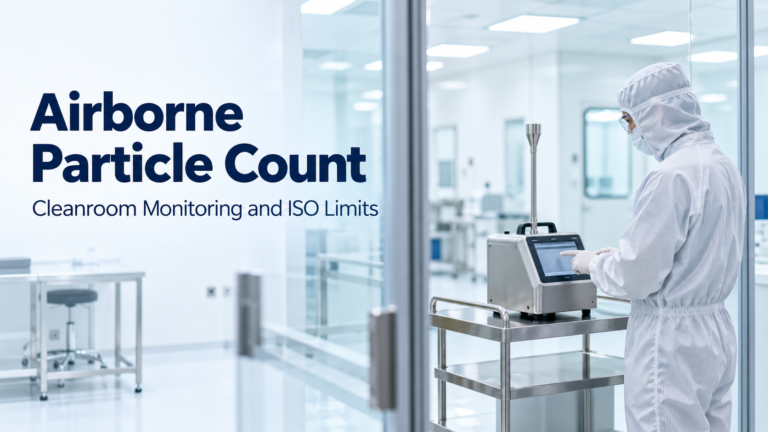
- Airborne particle counts — against the room’s ISO class, using a particle count test.
- Airflow velocity and air changes.
- HEPA filter integrity — confirming no leaks.
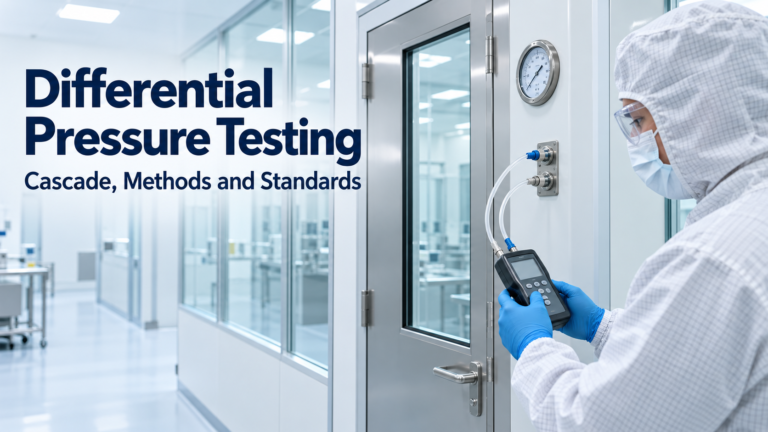
- Differential pressure — the correct cascade between rooms.
- Recovery, temperature and humidity where specified.
The ISO 14644 validation process
- Define the scope — agree the rooms, class, occupancy state and acceptance criteria.
- Verify instruments — confirm calibration and traceability.
- Apply the test methods — measure each parameter as the standard requires.
- Compare with the limits — record a pass or fail against the class.
- Report — issue documented, standards-based evidence of compliance.
Validation and classification
Classification and validation are two halves of the same picture. Cleanroom classification defines the target — the ISO class the room must achieve — while validation proves the room reaches that target and holds it in operation. You cannot meaningfully validate a room without first knowing the class it is meant to meet.
Standards and compliance
- ISO 14644 — the international series for cleanroom air cleanliness and test methods (ISO 14644 overview).
- GMP — Good Manufacturing Practice for pharmaceutical environments.
- NABL / ISO/IEC 17025 — accreditation for the testing laboratory.
Why validate to ISO 14644?
Because ISO 14644 is the common language of cleanrooms worldwide. Validating to it means your results are recognised by auditors, customers and regulators everywhere, and that your performance testing rests on methods the whole industry accepts — not a private interpretation.
How often should ISO 14644 validation be done?
Cleanrooms are validated when built or modified and requalified on a defined schedule, with routine testing in between. The interval follows the room’s class and the applicable framework.
Common mistakes to avoid
- Validating without the class — the target must be defined first.
- Wrong occupancy state — results must match the agreed condition.
- Skipping test methods — the standard covers more than particle counts.
- Uncalibrated instruments — results become indefensible.
Frequently asked questions
What is ISO 14644 validation in simple terms?
It is testing a cleanroom against the ISO 14644 standard to prove it meets its cleanliness class and holds it in use.
What does ISO 14644 cover?
A series of parts covering classification, monitoring, test methods and the design and operation of cleanrooms.
How is validation different from classification?
Classification sets the target class; validation proves the room reaches and holds that class.
What is tested in ISO 14644 validation?
Particle counts, airflow, air changes, HEPA integrity, differential pressure and, where specified, recovery, temperature and humidity.
Do you provide NABL-accredited ISO 14644 validation?
Yes. Vanavil Calibrations carries out NABL-accredited ISO 14644 validation on-site across Tamil Nadu.
Conclusion
ISO 14644 validation proves a cleanroom meets the standard the whole industry trusts. By measuring particles, airflow, pressure and filtration against the standard’s methods and limits, it confirms a room achieves and holds its class — giving hospitals, pharmaceutical plants and laboratories recognised, documented compliance.
Need ISO 14644 validation? Contact our team today. Vanavil Calibrations provides NABL-accredited ISO 14644 and clean room testing across Tamil Nadu with clear, audit-ready reports. Get in touch to plan your validation.