Operation Theatre Validation: HVAC, Air and Compliance Testing
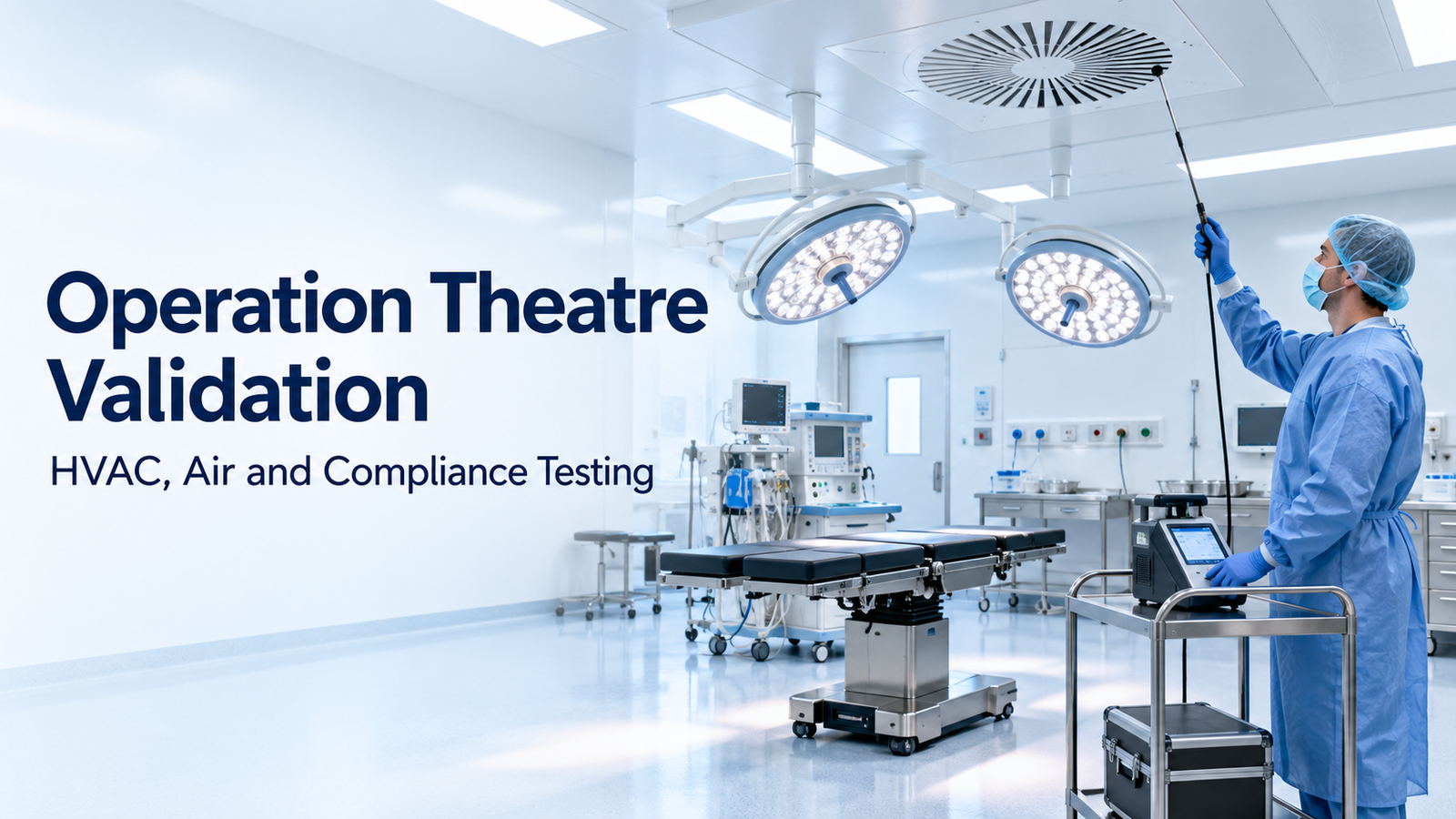
Operation theatre validation is the testing that proves a hospital operating theatre is delivering the clean, controlled air a surgical environment demands. An operating theatre is one of the most critical controlled spaces in any hospital, so operation theatre validation measures its air, airflow, pressure and filtration to confirm patients and staff are protected and the theatre is compliant.
This guide explains what operation theatre validation involves, why it matters, the parameters tested, the process, and the standards that apply.
Table of contents
- What is operation theatre validation?
- Why it matters
- What is tested
- Methods and instruments
- The validation process
- Standards and compliance
- FAQs
What is operation theatre validation?
Operation theatre validation is the structured testing of an operating theatre’s environment against its design and the applicable requirements. It confirms the theatre’s ventilation, filtration and pressure keep airborne contamination away from the surgical field. It uses the same core measurements as wider clean room performance testing, applied to the specific needs of a surgical space.
Why operation theatre validation matters
- Protects patients — clean air reduces the risk of surgical-site infection.
- Protects staff — controlled airflow and pressure support a safe theatre.
- Supports accreditation — hospital accreditation expects validated theatres.
- Confirms the HVAC — proves the air-handling system performs as designed.
What is tested in an operating theatre
Operation theatre validation typically covers:
- Airborne particle counts — against the required cleanliness level.
- Air changes per hour — enough ventilation to clear contamination.
- HEPA filter integrity — no leaks in the filters serving the theatre.
- Differential pressure — the correct positive cascade to adjoining areas.
- Airflow pattern and velocity — clean air delivered over the surgical zone.
- Temperature and humidity — comfortable, controlled conditions.
Only the criteria that genuinely apply to the theatre are used — no invented limits.
Methods and instruments
- Laser particle counters measure airborne cleanliness.
- Anemometers and balometers check airflow velocity and air changes.
- Aerosol photometers scan HEPA filters for leaks.
- Micro-manometers confirm the pressure cascade.
Because each reading supports a compliance record, calibrated, traceable instruments are essential. The filter and pressure checks follow the same principles as HEPA integrity testing and differential pressure testing.
The validation process
- Define the scope — agree the theatres, parameters and acceptance criteria.
- Verify instruments — confirm calibration and traceability.
- Measure each parameter — particles, air changes, filters, pressure and conditions.
- Compare with limits — record a pass or fail for each.
- Report — issue a clear, documented result with corrective actions if needed.
Standards and compliance
- ISO 14644 — cleanroom air cleanliness and test methods (ISO 14644 overview).
- Hospital accreditation requirements — the standards that apply to the facility, such as NABH in India.
- NABL / ISO/IEC 17025 — accreditation for the testing laboratory.
The operating theatre as a critical cleanroom
An operating theatre behaves like a high-grade cleanroom with extra demands: it must protect an open surgical site, cope with busy activity and hold its conditions through long procedures. Validating it links directly to the HVAC validation of the air-handling system that serves it.
How often should an operating theatre be validated?
Many hospitals validate theatres at least once a year, and again after any HVAC work, filter change or refurbishment that could affect the environment.
Common mistakes to avoid
- Testing only particles — pressure, air changes and filters matter too.
- Skipping the filter scan — a leaking HEPA defeats the theatre.
- Ignoring the pressure cascade — the theatre should stay positive to its surroundings.
- Uncalibrated instruments — results become indefensible.
Frequently asked questions
What is operation theatre validation in simple terms?
It is testing an operating theatre’s air, airflow, pressure and filters to prove it is clean, controlled and safe for surgery.
What is tested during OT validation?
Particle counts, air changes per hour, HEPA filter integrity, differential pressure, airflow and temperature and humidity.
Why is positive pressure used in a theatre?
So clean air always flows outward, keeping contamination from adjoining areas away from the surgical field.
How often should a theatre be validated?
At least annually, and again after any HVAC, filter or refurbishment work.
Do you provide NABL-accredited operation theatre validation?
Yes. Vanavil Calibrations carries out NABL-accredited operation theatre validation on-site across Tamil Nadu.
Conclusion
Operation theatre validation proves a theatre is a safe place to operate. By testing air cleanliness, air changes, filtration and pressure against recognised standards, it protects patients from infection and gives hospitals documented proof that their most critical rooms are performing exactly as they should.
Need your theatres validated? Contact our team today. Vanavil Calibrations provides NABL-accredited operation theatre and clean room testing across Tamil Nadu with clear, audit-ready reports. Get in touch to schedule your validation.