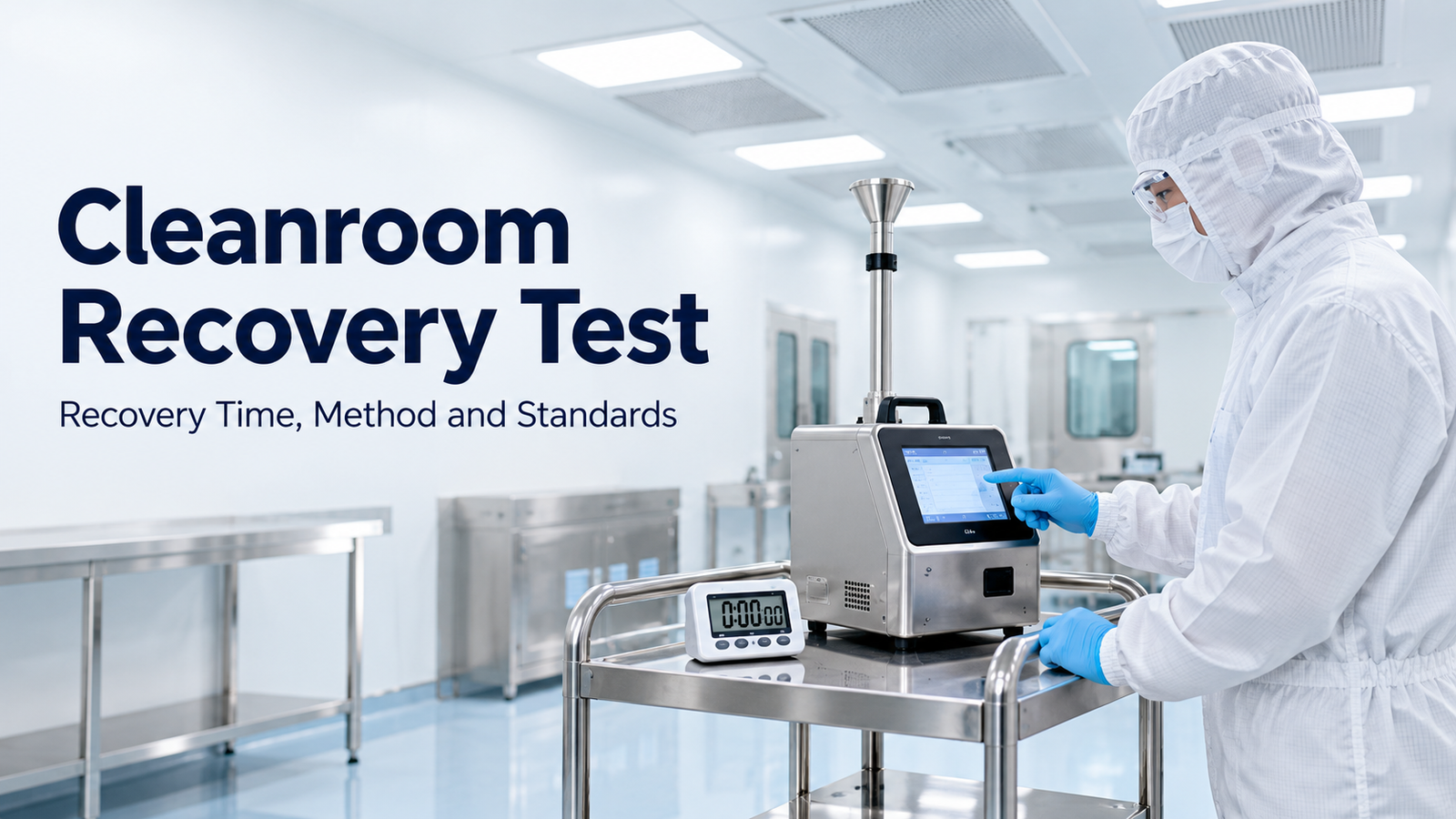
Cleanroom Recovery Test: Recovery Time, Method and Standards
A cleanroom recovery test measures how quickly a room can clean itself — how fast it clears airborne particles and returns to its normal cleanliness after a deliberate contamination challenge. A room that meets its particle limit at rest can still recover too slowly to be safe in real use, so the cleanroom recovery test proves the ventilation is strong enough to restore cleanliness quickly after any disturbance.
This guide explains what a cleanroom recovery test involves, why recovery time matters, the method and instruments, and the standards that apply.
Table of contents
- What is a cleanroom recovery test?
- Why recovery time matters
- What it measures
- Method and instruments
- The testing process
- Standards and compliance
- FAQs
What is a cleanroom recovery test?
A cleanroom recovery test measures the time a room takes to reduce its airborne particle concentration back to a defined level after that concentration has been deliberately raised. It shows how effectively the room’s air changes flush out contamination, and it is one of the more revealing checks within clean room performance testing. The test is most relevant to non-unidirectional (turbulently ventilated) rooms, where clean air mixes with and dilutes the contaminated air rather than sweeping it out in one direction.
Why recovery time matters
- Proves real-world resilience — a room is constantly disturbed by people, doors and processes.
- Confirms ventilation strength — fast recovery shows the air changes are doing their job.
- Protects production — the room can return to its class between operations.
- Detects hidden weakness — slow recovery reveals poor airflow even when a static count passes.
What a cleanroom recovery test measures
- Recovery time — the time to fall from a raised concentration to a target level.
- Decay rate — how the particle count drops over the measured period.
- Recovery ratio — often expressed as the time to cut the concentration by a set factor.
- Consistency — whether recovery is similar at different points in the room.
Only the recovery target that genuinely applies to a facility is used — no invented figures.
Method and instruments
- A particle challenge — the concentration is raised in a controlled way to start the test.
- Laser particle counters record the falling concentration over time.
- A timer and defined end point mark when the target level is reached.
- Representative locations ensure recovery is assessed where it matters.
Because each reading may support a compliance record, calibrated, traceable instruments are essential. Recovery depends directly on the room’s air changes per hour.
The recovery testing process
- Define the scope — agree the rooms, target and acceptance criteria.
- Verify instruments — confirm calibration and traceability.
- Raise the concentration — introduce a controlled particle challenge.
- Record the decay — measure the falling particle count over time.
- Determine recovery time — note when the target level is reached.
- Report — document the recovery time and a pass or fail against the target.
Standards and compliance
- ISO 14644 — cleanroom air cleanliness and test methods, including recovery (ISO 14644 overview).
- GMP — Good Manufacturing Practice for pharmaceutical environments.
- NABL / ISO/IEC 17025 — accreditation for the testing laboratory.
Recovery and air changes
Recovery time and air changes per hour are two sides of the same coin: the more times a room’s air is replaced each hour, the faster it clears a contamination challenge. A slow recovery often points straight back to insufficient air changes or weak airflow, which is why the two results are read together with the room’s particle count test.
Where recovery testing is used
- Pharmaceutical and biotechnology — rooms that must reset between batches.
- Hospitals and healthcare — areas that recover between procedures.
- Medical device and electronics — controlled assembly spaces.
- Laboratories — research and quality-control cleanrooms.
How often should a recovery test be done?
Recovery is usually tested when a room is qualified and then periodically, and again after any change to the ventilation, because a weakening fan or loaded filter lengthens recovery time.
Common mistakes to avoid
- Testing unidirectional rooms the wrong way — recovery is mainly for turbulently ventilated rooms.
- Inconsistent challenge — the starting concentration must be controlled.
- Uncalibrated counters — results become indefensible.
- Ignoring air changes — recovery and ACPH should be read together.
Frequently asked questions
What is a cleanroom recovery test in simple terms?
It measures how long a room takes to clear airborne particles and return to its normal cleanliness after the level is deliberately raised.
Why is recovery time important?
Because a real room is constantly disturbed; fast recovery proves it can restore cleanliness between operations.
Which rooms need a recovery test?
Mainly non-unidirectional, turbulently ventilated rooms, where clean air dilutes contamination rather than sweeping it out.
How is recovery time measured?
By raising the particle concentration, then recording how long it takes to fall to the target level with a calibrated particle counter.
Do you provide NABL-accredited recovery testing?
Yes. Vanavil Calibrations carries out NABL-accredited cleanroom recovery testing on-site across Tamil Nadu.
Conclusion
A cleanroom recovery test proves a room can clean itself quickly after any disturbance. By measuring how fast airborne particles fall back to the target level against ISO 14644 methods, it confirms the ventilation is strong enough for real use — keeping cleanrooms in hospitals, pharmaceutical plants and laboratories dependable between operations.
Need your recovery time verified? Contact our team today. Vanavil Calibrations provides NABL-accredited recovery and clean room testing across Tamil Nadu with clear, audit-ready reports. Get in touch to schedule your testing.