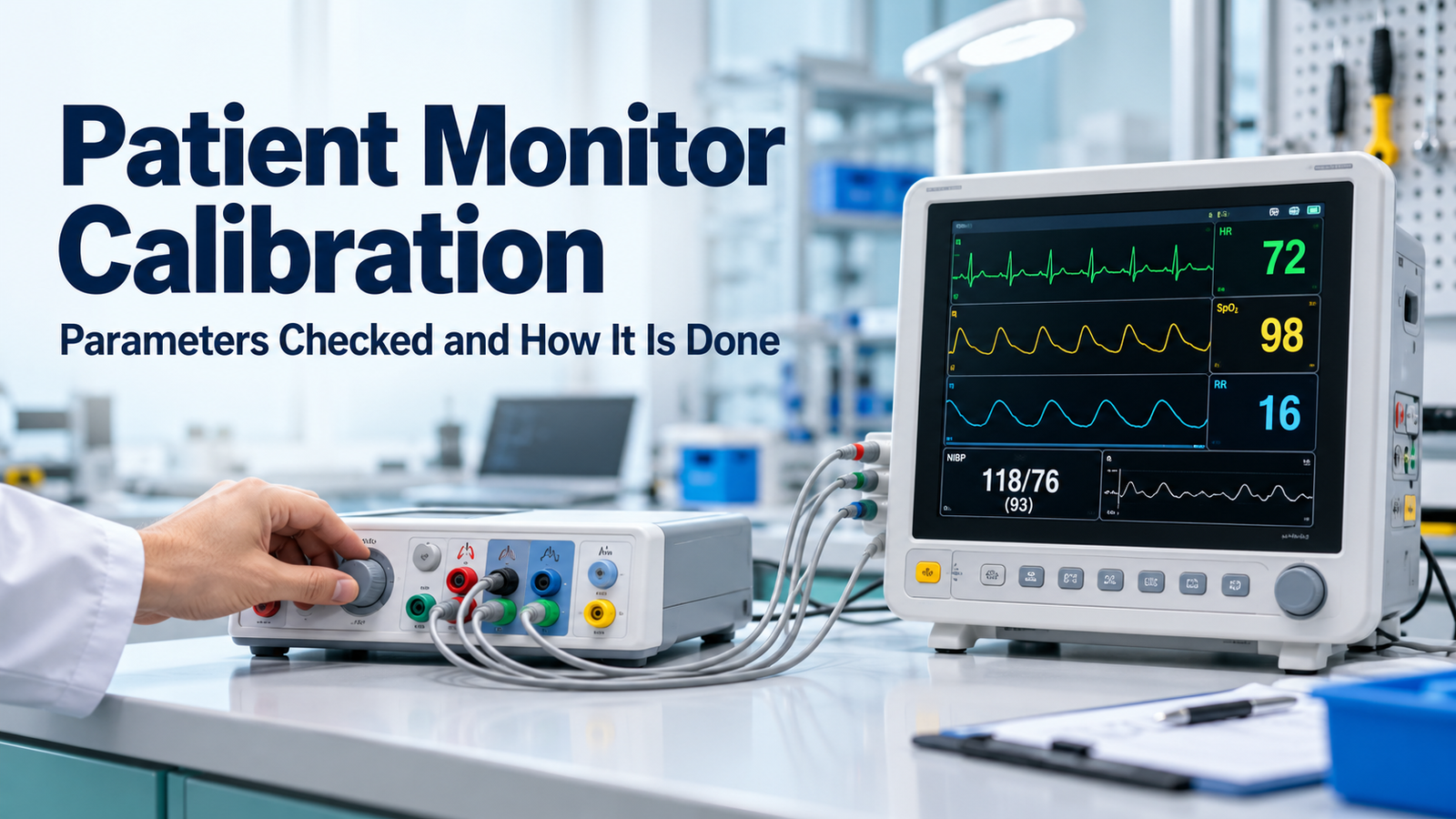
Patient Monitor Calibration: Parameters Checked and How It Is Done
Patient monitors sit beside almost every bed in critical care, recovery and emergency departments. Staff glance at them hundreds of times a shift and trust what they see. Patient monitor calibration is how a hospital confirms that trust is justified — that the heart rate, oxygen saturation, blood pressure and temperature on screen match what is really happening.
This article explains which parameters are checked, how the work is done and how often it should be repeated.
Table of contents
- Why patient monitors drift
- Parameters checked
- How calibration is done
- How often to calibrate
- Tips for biomedical teams
- A worked example: calibrating an ICU monitor
- Common problems found in patient monitors
- Documentation that stands up in audits
- Central stations, networks and alarm transfer
- Frequently asked questions
Why patient monitors drift
A multiparameter monitor combines several measurement systems in one box: ECG amplifiers, pulse oximetry, a non-invasive blood pressure pump and valve, temperature inputs and often respiration. Each can drift in its own way. Pressure transducers age, cuffs and hoses leak, SpO2 sensors wear, and internal references shift with heat and time.
None of this is usually visible to the user. The monitor keeps showing numbers; they are just slightly less accurate than before. Calibration makes the drift visible.
Parameters checked
A typical multiparameter monitor calibration covers:
- ECG — heart rate accuracy at several rates, and alarm response
- SpO2 — saturation and pulse rate against simulated values
- NIBP — static pressure accuracy, leak test and simulated readings
- Temperature — accuracy at points across the clinical range
- Respiration — respiration rate where the monitor supports it
- IBP — invasive pressure channels, where fitted
- Alarms — high and low alarm limits trigger correctly
How calibration is done
Calibration uses a patient simulator and reference instruments that are themselves calibrated and traceable. The simulator produces known ECG waveforms, SpO2 values, temperatures and pressures. The engineer compares each reading on the monitor with the known input and records the difference.
- The monitor is identified and inspected, including cables, cuffs and sensors.
- Each parameter is tested at several points, not just one.
- Readings are compared with the tolerance in the manufacturer’s specification.
- Results, measurement uncertainty and pass/fail status are written onto a certificate.
Accessories matter. A worn SpO2 sensor or a leaking NIBP cuff can make a healthy monitor look faulty, so accessories should be checked or replaced as part of the visit.
How often to calibrate
Most hospitals calibrate patient monitors at least once a year and after any repair or major service. Monitors in heavy-use areas such as ICU and emergency, or units with a history of drift, may need more frequent checks. Your hospital’s quality policy and the manufacturer’s service manual should guide the final interval. Our overview of medical device calibration intervals covers this in more detail.
Tips for biomedical teams
- Keep a register of every monitor with serial number, location and due date.
- Calibrate monitors department by department so no area is left without cover.
- Record accessory condition alongside monitor results.
- Review failure history each year to adjust intervals.
- Check that each parameter you need is within your provider’s NABL scope.
A worked example: calibrating an ICU monitor
Consider a typical multiparameter monitor in an intensive care unit with ECG, SpO2, NIBP, temperature and one invasive pressure channel. A calibration visit for this monitor would usually run like this:
- Identification and inspection. The engineer records the asset number and serial number, checks the case, screen, mounting and power cable, and inspects every accessory: ECG trunk cable and leads, SpO2 sensor and extension, NIBP hose and cuff, temperature probe and IBP cable.
- ECG. The simulator outputs heart rates across the clinical range. The engineer notes the displayed rate at each point, checks the waveform and triggers high and low heart rate alarms.
- SpO2. Saturation values are simulated at several levels, including low values where alarms should activate, and the displayed pulse rate is compared.
- NIBP. A static pressure check compares the monitor’s transducer with a reference manometer, a leak test checks the pneumatic system and simulated readings check the displayed values.
- Temperature and IBP. Known values are applied and readings compared, including zeroing of the pressure channel.
- Documentation. Each result is recorded against the manufacturer’s tolerance with measurement uncertainty, and the monitor is labelled with its next due date.
If one parameter fails, for example the NIBP leak test, the monitor can often stay in use for other parameters only if hospital policy allows it and the failed channel is clearly disabled. Most hospitals prefer to replace the faulty accessory or repair the module and retest before full use.
Common problems found in patient monitors
- Damaged SpO2 sensors causing erratic or low readings.
- NIBP hose leaks leading to repeated “measurement failed” messages.
- ECG lead wire breaks that show as noise or lead-off alarms.
- Alarm limits set too wide or alarm volume turned down.
- Clock and date errors that affect trend records and event logs.
Most of these are fixed by replacing accessories or correcting settings, which is why accessory inspection is part of every calibration.
Documentation that stands up in audits
Auditors usually want to see three things for patient monitors: a complete register, current certificates and evidence that failures were acted on. Keep certificates linked to asset numbers, file repair reports next to the re-calibration that followed, and make sure the due date label on each monitor matches your register. A short summary of results by ward also helps your quality team show trends at review meetings.
Central stations, networks and alarm transfer
Many ICUs connect bedside monitors to a central station at the nursing desk. Calibration measures accuracy at the bedside, but the network adds its own risks. A monitor may read correctly while its data reaches the central station late, under the wrong bed number or without its alarms. After calibrating the bedside monitors, it is good practice to trigger a test alarm on each bed and confirm it appears at the central station with the right bed label and priority. Also check that trends and event logs show the correct time, because incorrect clocks make it difficult to review incidents later.
When monitors are replaced or moved between beds, update the central station configuration at the same time. A short sign-off sheet completed by the biomedical and nursing teams after each change helps keep the system reliable and gives auditors clear evidence that alarm transfer was checked.

Frequently asked questions
Can patient monitors be calibrated at the bedside?
Yes. Using a portable patient simulator, monitors can be calibrated on-site with little disruption. The monitor under test is briefly unavailable, so testing is planned around patient needs.
Does calibration include the SpO2 sensor?
The monitor’s SpO2 channel is tested with a simulator. Sensors are inspected and, where damaged or worn, should be replaced because they affect real-world accuracy.
What if one parameter fails?
The failed channel should be taken out of use or the monitor withdrawn until it is repaired and re-calibrated. The certificate records which parameter failed.
Do central monitoring stations need calibration?
Central stations display data from bedside monitors. Measurement accuracy is checked at the bedside monitor; the central station should be checked for correct display and alarm transfer.
Should monitor accessories be replaced at every calibration?
Not automatically. Accessories are inspected and tested with the monitor; worn or damaged items are replaced. Keeping a stock of spare accessories on each ward avoids delays.
Do transport monitors need separate calibration?
Yes. Transport and portable monitors should be registered and calibrated like bedside monitors, with extra attention to battery condition.
Conclusion
Patient monitor calibration protects the readings clinicians rely on every minute. With a patient simulator, traceable references and a clear schedule, hospitals can prove their monitors are accurate and catch drift early.
External reference: NABL India.
Need your monitors calibrated? Vanavil Calibrations calibrates patient monitors and other medical equipment on-site for hospitals across Tamil Nadu. Talk to our team.