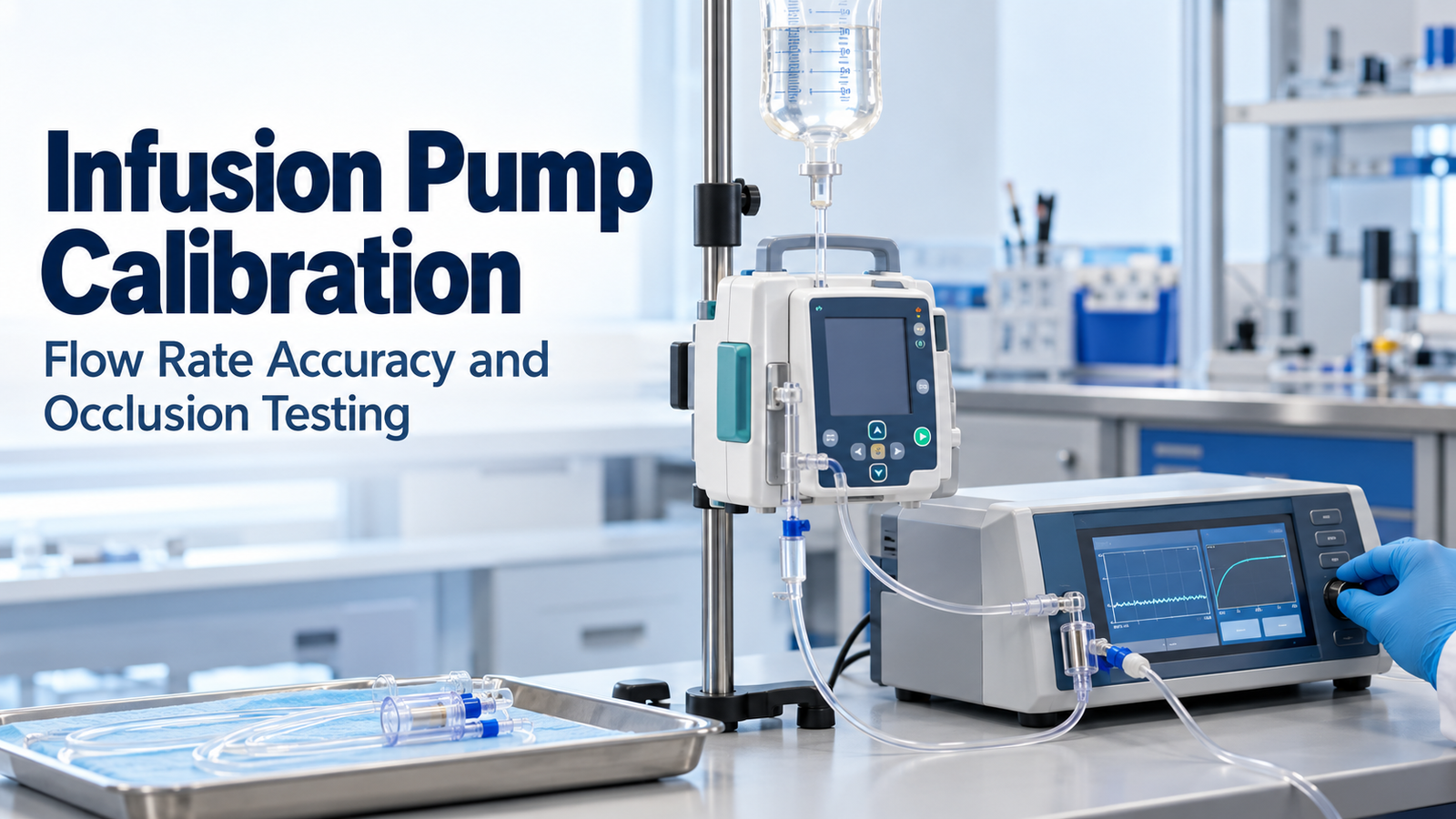
Infusion Pump Calibration: Flow Rate Accuracy and Occlusion Testing
Infusion pumps deliver fluids, drugs and nutrition at controlled rates, often for hours at a time. A small error in flow rate adds up over a long infusion. Infusion pump calibration measures what the pump actually delivers and checks that its safety alarms, especially occlusion detection, respond correctly.
Table of contents
- Why flow accuracy matters
- Tests performed
- How the analyser works
- How often to calibrate
- Tips for hospitals
- What good infusion pump records look like
- A worked example: testing a volumetric pump
- Common problems found in infusion pumps
- Drug libraries and settings
- Managing a large pump fleet
- Preparing pumps for calibration
- Frequently asked questions
Why flow accuracy matters
Many infusions are dose-critical: small differences in delivery rate change how much drug the patient receives. Pump mechanisms wear, sensors drift and infusion sets vary. Calibration shows whether the pump is still within its specified accuracy under realistic conditions.
Tests performed
- Flow rate accuracy at typical and extreme rates
- Volume delivered against volume set
- Occlusion pressure — the pressure at which the downstream occlusion alarm triggers
- Bolus released after an occlusion is cleared
- Alarms — air-in-line, door open, end of infusion and low battery
- Visual and electrical safety checks
How the analyser works
An infusion device analyser collects the fluid delivered by the pump and measures flow and volume over time. It also creates a controlled blockage to measure the occlusion pressure and the bolus released. The analyser is itself calibrated and traceable, which is what makes the results reliable.
Testing is usually done with the infusion set type used in your hospital, because set design affects accuracy.
How often to calibrate
Annual calibration is common, with extra checks after repair, drops or fluid ingress. Pumps in heavy use, such as in ICU and oncology, may justify shorter intervals. See our medical device calibration guide for how to set intervals.
Tips for hospitals
- Record every pump with serial number, ward and due date.
- Test with your usual infusion set brand.
- Rotate pumps so wards are never short during testing.
- Review occlusion alarm results as closely as flow results.
Syringe pumps need similar but slightly different checks. Read our article on syringe pump calibration.
What good infusion pump records look like
A calibration certificate is only useful if it can be found and linked to the right pump. Strong records make audits quicker and help your team spot patterns:
- Unique ID: every pump has an asset number that appears on its label and certificate.
- Location history: which ward the pump was in, so failures can be traced to usage.
- Results, not just pass/fail: measured flow error and occlusion pressure let you see drift over the years.
- Repairs: each repair is followed by a re-calibration entry.
- Infusion set used: noted on the certificate, because set type affects accuracy.
Reviewing these records once a year shows which models are reliable and which need attention. That insight feeds directly into procurement decisions and service contracts. For the wider programme, our medical equipment calibration page explains how we organise hospital-wide schedules.
A worked example: testing a volumetric pump
A typical infusion pump calibration follows a clear sequence. First, the engineer inspects the pump housing, door mechanism, keypad, pole clamp and mains cable, and checks the battery. The pump is loaded with the infusion set normally used in the hospital and primed with water.
Next, the pump is connected to the infusion device analyser. The engineer runs the pump at a commonly used rate and lets the analyser collect enough volume to calculate an accurate flow rate. The test is repeated at a second rate, often a low rate used for critical drugs. The analyser reports flow error and delivered volume, which are compared with the manufacturer’s specification.
The occlusion test follows. The analyser gradually blocks the downstream line and records the pressure at which the pump alarms and the time it takes. When the occlusion is released, the analyser measures the bolus delivered. Finally, air-in-line, door-open and end-of-infusion alarms are triggered, and the result is recorded on the certificate.
Common problems found in infusion pumps
- Worn pumping mechanisms causing flow to fall outside tolerance.
- Door and latch damage that affects how the set is held.
- Air-in-line sensors that are dirty or damaged.
- Fluid ingress after spills, affecting sensors and electronics.
- Batteries that no longer last through patient transfers.
Drug libraries and settings
Many modern pumps use drug libraries with dose limits. Calibration confirms the pump delivers accurately; it does not check that the library content is clinically correct. Keep drug library updates under the control of pharmacy and nursing leads, and record the library version on each pump alongside its calibration status. After a software or library update, a quick functional check confirms the pump still operates as expected.
Managing a large pump fleet
Hospitals often have more infusion pumps than any other device type. Group them by model so testing is efficient, rotate them through the biomedical department ward by ward, and keep a small pool of spare calibrated pumps. Tracking failure rates by model helps inform future purchasing decisions.
Preparing pumps for calibration
Infusion pump testing is quicker when pumps arrive clean, charged and complete. Ask wards to send pumps with their pole clamps and mains cables, clean off any dried fluid, and report known faults on a tag so the engineer can check them specifically. Provide a supply of the infusion sets your hospital normally uses, because testing with the same sets gives the most realistic results.
Plan the rotation so each ward keeps enough pumps for its patients. A common approach is to collect a batch of pumps from one area, calibrate them, return them and then collect the next batch. Keep a simple sign-out sheet so every pump is accounted for, and confirm that calibration labels are visible before pumps go back into clinical use. Any pump that fails should be clearly tagged and kept apart until it has been repaired and retested.
Frequently asked questions
How long does an infusion pump test take?
Flow tests need time for enough fluid to be collected, so each pump takes a while. We test several pumps in parallel where possible and agree the plan with your biomedical team.
Why test the occlusion alarm?
If a line is blocked, the pump must detect it and alarm before pressure builds too high. A late alarm can delay treatment; a large bolus after clearing can over-deliver.
Can infusion pumps be calibrated on-site?
Yes. Infusion device analysers are portable, so pumps are usually tested on-site.
Does the infusion set affect results?
Yes. Different sets can change accuracy, so testing with the set you normally use gives the most realistic result.
Do pumps need calibration after a software update?
A functional check is sensible after software updates. Full calibration is required if the update affects delivery or the manufacturer recommends it.
Are enteral feeding pumps included?
Yes. Enteral pumps deliver volumes to patients and should be registered and checked for delivery accuracy and alarms.
Conclusion
Infusion pump calibration confirms that pumps deliver the right volume at the right rate and alarm when something goes wrong. It is a core part of any hospital’s medical equipment programme.
External reference: NABL India.
Need infusion pumps calibrated? See our medical equipment calibration service or contact us to plan a visit.