Ventilator Calibration: Performance Checks Every Hospital Should Know
A ventilator does the work of breathing for a patient who cannot. Small errors in delivered volume, pressure or oxygen concentration can have real consequences. Ventilator calibration confirms that what the ventilator delivers matches what the clinician has set, and that its alarms respond when they should.
This guide covers the parameters checked, how the test is carried out and how to plan it in a busy ICU.
Table of contents
- Why ventilator calibration matters
- Parameters checked
- How the test is done
- How often to calibrate
- Planning around the ICU
- Testing across ventilation modes
- Common problems found in ventilators
- Working with the ICU team
- What your records should show
- Keeping ventilators reliable between calibrations
- Frequently asked questions
Why ventilator calibration matters
Ventilators rely on flow sensors, pressure transducers and oxygen sensors. All of these age and drift. An oxygen cell nearing the end of its life, a contaminated flow sensor or a slow leak can change what reaches the patient without an obvious fault message.
Calibration measures actual delivery with an independent, traceable analyser, so drift is caught before it affects care. It also provides the documented evidence that accreditation and quality audits look for.
Parameters checked
- Tidal volume — delivered volume against set volume
- Minute volume and respiratory rate
- Peak and plateau pressure
- PEEP — positive end-expiratory pressure
- FiO2 — delivered oxygen concentration
- Inspiratory time and I:E ratio
- Alarms — high pressure, low volume, disconnection and oxygen alarms
The exact list depends on the ventilator type and modes in use. Transport ventilators and anaesthesia workstations share many of the same checks.
How the test is done
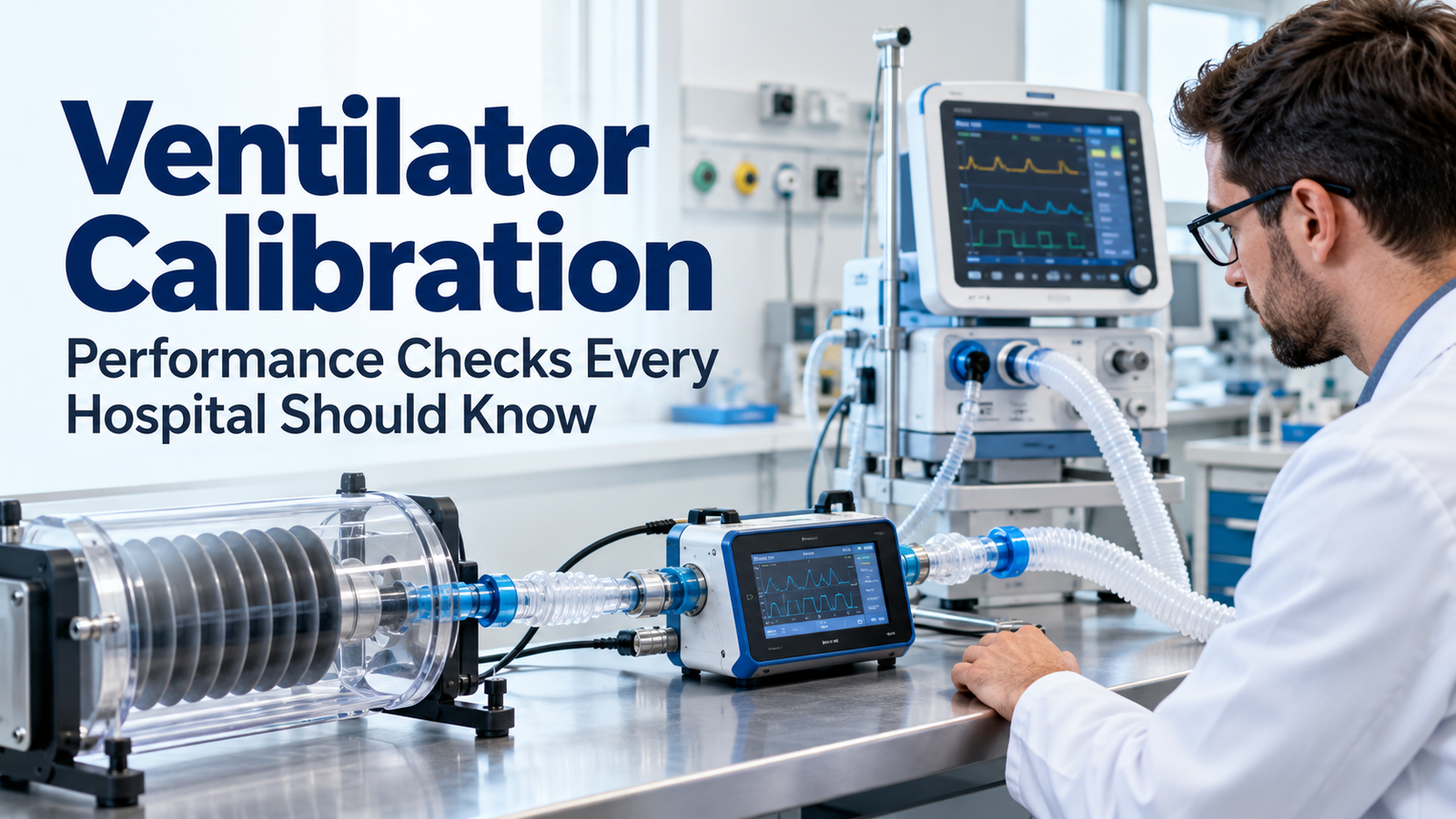
The ventilator is connected to a gas flow analyser and a test lung. The analyser measures flow, volume, pressure and oxygen concentration independently of the ventilator’s own sensors.
- The ventilator runs its self-test and the circuit is checked for leaks.
- Settings are applied in common modes, and delivered values are measured by the analyser.
- Each result is compared with the manufacturer’s tolerance.
- Alarms are triggered deliberately to confirm they respond.
- Results, uncertainty and status are recorded on a certificate.
The analyser used should itself carry a valid, traceable calibration. Ask your provider about this, and whether the parameters fall within their NABL scope. Our guide to medical device calibration explains why this matters.
How often to calibrate
Ventilators are usually calibrated at least once a year, with performance checks after servicing, sensor replacement or repair. Many manufacturers also specify routine operator checks, such as flow sensor and oxygen cell calibration, before use. Those operator checks complement but do not replace an independent calibration.
Planning around the ICU
- Calibrate spare or standby ventilators first, then rotate clinical units.
- Schedule testing with the ICU in-charge so patient care is never compromised.
- Replace consumables such as oxygen cells and flow sensors before testing where due.
- Keep certificates and due dates in one register for all critical care equipment.
If your ICU also needs air quality checks, see our hospital validation services.
Testing across ventilation modes
Modern ventilators offer many modes: volume control, pressure control, pressure support, synchronised intermittent mandatory ventilation and non-invasive modes. It is rarely practical to test every combination. Instead, calibration focuses on the modes your ICU uses most, and on the core measurements that underpin all of them: delivered volume, pressure, oxygen concentration and timing.
For a volume-controlled mode, the engineer sets a tidal volume and rate and measures the delivered volume and peak pressure with the gas flow analyser. For a pressure-controlled mode, the engineer sets an inspiratory pressure and checks the pressure reached and the resulting volume in a test lung. PEEP is checked at more than one setting. Oxygen concentration is measured at low and high settings to confirm the blender and oxygen sensor are accurate.
Common problems found in ventilators
- Oxygen cells near end of life, showing slow response or low readings.
- Contaminated or damaged flow sensors affecting volume measurement.
- Leaks in the patient circuit, exhalation valve or internal connections.
- Worn batteries in transport and backup systems.
- Alarm limits set outside the unit’s standard defaults.
Most of these are consumable or maintenance items. Replacing them before the calibration visit, where they are due, saves repeat testing.
Working with the ICU team
Ventilator calibration works best as a joint effort between the biomedical department, ICU nursing leads and the calibration provider. Agree in advance which ventilators will be tested on which day, keep at least one calibrated standby unit available, and make sure clinical staff know when each unit returns to service. After calibration, share a short summary with the ICU team: which units passed, which needed parts, and when the next checks are due.
What your records should show
- Ventilator asset number, model, software version and location.
- Analyser used and its own calibration status.
- Measured volume, pressure, PEEP and oxygen values against settings.
- Alarm tests performed and their results.
- Parts replaced and any retest carried out.
These details make it easy to spot a ventilator that drifts year after year and plan its replacement before it fails in use.
Keeping ventilators reliable between calibrations
Annual calibration confirms performance at one point in time. What happens between visits matters just as much. The most effective habits are simple and are usually already in the manufacturer’s instructions:
- Run the pre-use check before each new patient, including leak and compliance tests, and never skip it under time pressure.
- Calibrate the oxygen sensor and flow sensor as the operator manual requires, and replace them on schedule.
- Use the correct circuits and filters for the ventilator model; the wrong components can change measured values.
- Keep batteries charged and test backup power periodically, especially for transport ventilators.
- Report unusual behaviour such as unexplained alarms or changes in delivered volume straight away.
Logging these checks gives the biomedical team early warning of units that are starting to drift, so they can be serviced before the next scheduled calibration.

Frequently asked questions
Is the ventilator’s self-test enough?
No. A self-test checks the ventilator using its own sensors. Independent calibration uses an external, traceable analyser to confirm the ventilator’s delivery is accurate.
Can ventilators be calibrated on-site?
Yes. With a portable gas flow analyser and test lung, ventilators are calibrated on-site in the ICU or biomedical workshop.
How long does a ventilator calibration take?
It depends on the model, the modes tested and any corrective work needed. We agree timing with your ICU team before the visit.
Do anaesthesia workstations need the same checks?
Many of the same parameters apply, including volume, pressure and oxygen concentration, together with checks specific to anaesthesia delivery.
Should transport ventilators be calibrated too?
Yes. Transport ventilators support patients during movement and emergencies. They should be registered and calibrated like ICU ventilators, with battery checks included.
Can a ventilator stay in use if one alarm fails?
Alarm failures are safety issues. The ventilator should normally be withdrawn and repaired, then retested before returning to clinical use.
Conclusion
Ventilator calibration gives ICU and biomedical teams independent proof that ventilators deliver what they are set to deliver. Combined with good operator checks and a clear schedule, it keeps critical care safer and audit-ready.
External reference: NABL India.
Need ventilators calibrated? Vanavil Calibrations provides on-site medical equipment calibration for hospitals across Tamil Nadu. Contact us to plan a visit.