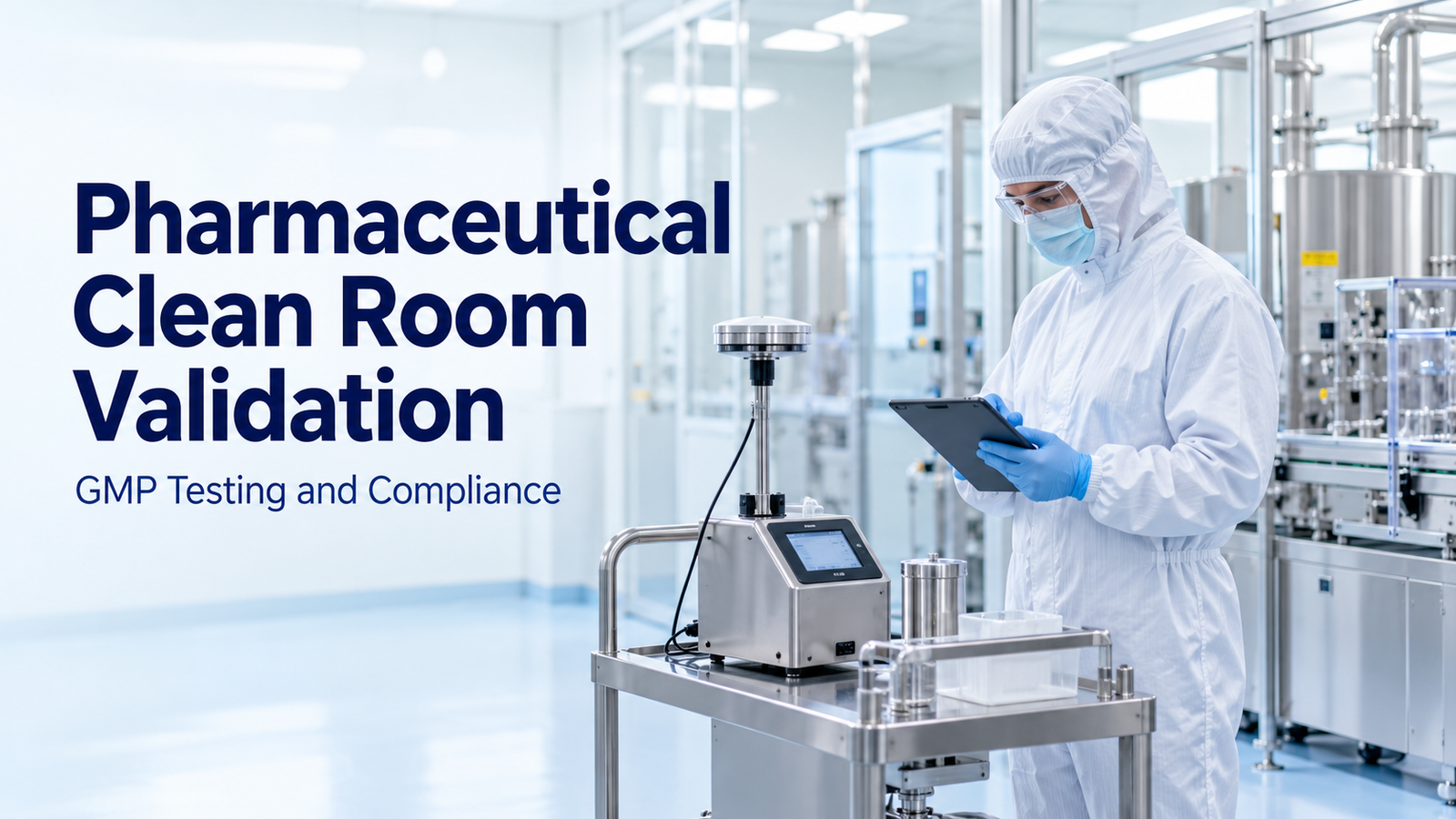
Pharmaceutical Clean Room Validation: GMP Testing and Compliance
Pharmaceutical clean room validation is the documented proof that a cleanroom used to make medicines meets the strict standards that protect product quality and patient safety. In pharmaceutical manufacturing, an unproven cleanroom is a regulatory and safety risk, so pharmaceutical clean room validation tests every critical parameter against GMP and ISO 14644 and records the evidence an inspector will expect to see.
This guide explains what pharmaceutical clean room validation involves, the GMP grades, the tests, the process, and the standards that apply.
Table of contents
- What is pharmaceutical clean room validation?
- Why it matters
- GMP grades and ISO classes
- What is tested
- The validation process
- Standards and compliance
- FAQs
What is pharmaceutical clean room validation?
Pharmaceutical clean room validation is the structured testing and documentation that proves a production cleanroom performs to its required cleanliness grade and holds it in real use. It builds on general cleanroom validation but adds the specific expectations of Good Manufacturing Practice, where the environment directly affects the safety of the medicine being made.
Why pharmaceutical clean room validation matters
- Patient safety — a controlled environment protects sterile and non-sterile products.
- Regulatory compliance — inspectors require validated, documented cleanrooms.
- Product quality — consistent conditions mean consistent product.
- Batch protection — validation guards against contamination that could ruin a batch.
GMP grades and ISO classes
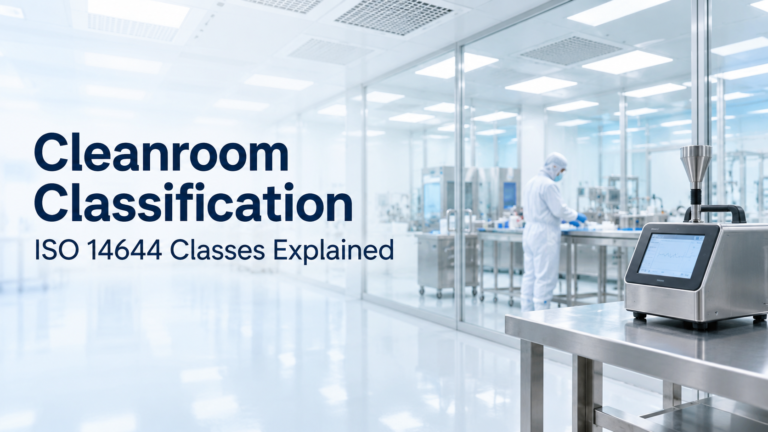
Pharmaceutical cleanrooms are described by GMP grades — commonly Grades A, B, C and D — each corresponding to a level of air cleanliness for a particular activity. Grade A covers the most critical operations, such as sterile filling, while lower grades cover supporting areas. These grades map onto the ISO 14644 particle classes, so validation confirms both the GMP grade and the ISO class that applies. Only the grade that genuinely applies to an operation is used — no invented requirements.
What is tested
Pharmaceutical clean room validation typically covers:
- Airborne particle counts in the required occupancy states.
- Air changes per hour and airflow to clear contamination.
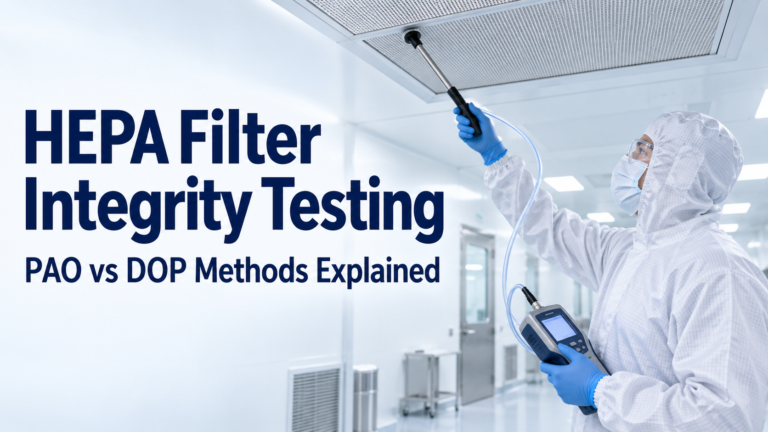
- HEPA filter integrity with no leaks, confirmed by a scan.
- Differential pressure maintaining the correct cascade.
- Recovery, temperature and humidity.
- Microbial monitoring where the facility runs viable sampling.
The filter checks follow the same principles as a HEPA filter integrity test.
The validation process
- Define the scope — agree rooms, grades, occupancy states and acceptance criteria.
- Verify instruments — confirm calibration and traceability.
- Run IQ, OQ and PQ — installation, operational and performance qualification where required.
- Measure every parameter — particles, airflow, pressure, filters and conditions.
- Document everything — record results, deviations and a pass or fail per test.
- Issue the report — provide the validated, audit-ready evidence.
Standards and compliance
- GMP — Good Manufacturing Practice, including the requirements that apply to the facility, such as Schedule M in India.
- ISO 14644 — cleanroom air cleanliness and test methods (ISO 14644 overview).
- NABL / ISO/IEC 17025 — accreditation for the testing laboratory.
Validation, certification and monitoring
Validation proves the cleanroom performs; certification records the result; and ongoing monitoring shows it stays in control between validations. Together they give a pharmaceutical facility a complete, defensible picture of its controlled environment.
How often is pharmaceutical clean room validation needed?
Cleanrooms are validated when built or modified, and requalified on a defined schedule, with routine testing in between. The exact frequency follows the facility’s risk assessment and the applicable GMP requirements.
Common mistakes to avoid
- Testing only at rest — operational results matter for real production.
- Weak documentation — an unrecorded result is not defensible.
- Ignoring microbial risk — sterile areas need viable monitoring too.
- Uncalibrated instruments — results become indefensible.
Frequently asked questions
What is pharmaceutical clean room validation in simple terms?
It is proving, with tests and documentation, that a medicine-making cleanroom meets its GMP grade and holds it in real use.
What are GMP grades?
Grades A to D describe levels of air cleanliness for different activities, mapping onto the ISO 14644 classes.
What is tested in a pharmaceutical cleanroom?
Particle counts, air changes, HEPA integrity, pressure, recovery, temperature and humidity, plus microbial monitoring where applicable.
How often is validation required?
At build or modification, then requalified on a defined schedule with routine testing in between.
Do you provide NABL-accredited pharmaceutical clean room validation?
Yes. Vanavil Calibrations carries out NABL-accredited pharmaceutical clean room validation on-site across Tamil Nadu.
Conclusion
Pharmaceutical clean room validation is what lets a facility make medicines with confidence. By testing every critical parameter against GMP and ISO 14644 and documenting the evidence, it protects patients, satisfies inspectors and gives manufacturers proof that their cleanrooms are fit to produce safe, quality product.
Need your pharmaceutical cleanrooms validated? Contact our team today. Vanavil Calibrations provides NABL-accredited pharmaceutical clean room validation across Tamil Nadu with clear, audit-ready reports. Get in touch to plan your validation.