Syringe Pump Calibration: Methods, Accuracy Checks and Frequency
Syringe pumps are used where small volumes must be delivered precisely, often at very low rates: sedation, inotropes, insulin and neonatal infusions. At these rates even small errors matter. Syringe pump calibration confirms that the pump pushes the plunger at the correct speed for the syringe in use and alarms when it should.
Table of contents
- How syringe pumps differ from infusion pumps
- Checks performed
- Calibration method
- How often to calibrate
- Good practice between calibrations
- A worked example: low-rate syringe pump testing
- Common problems found in syringe pumps
- Syringe libraries and brand changes
- What good records look like
- Preparing syringe pumps for calibration
- Training staff to support accuracy
- Frequently asked questions
How syringe pumps differ from infusion pumps
A syringe pump drives the plunger of a syringe with a lead screw. Its accuracy depends on the drive mechanism and on correctly recognising the syringe size and brand, because the pump calculates volume from plunger movement and syringe diameter. That is why syringe settings are part of the calibration, not just flow rate.
Checks performed
- Flow rate accuracy, including low rates used in critical and neonatal care
- Syringe size and brand recognition
- Occlusion pressure and alarm response
- Bolus function and post-occlusion bolus
- Alarms — near empty, end of infusion, syringe disengaged and battery
- Mechanical inspection of the plunger clamp and drive
Calibration method
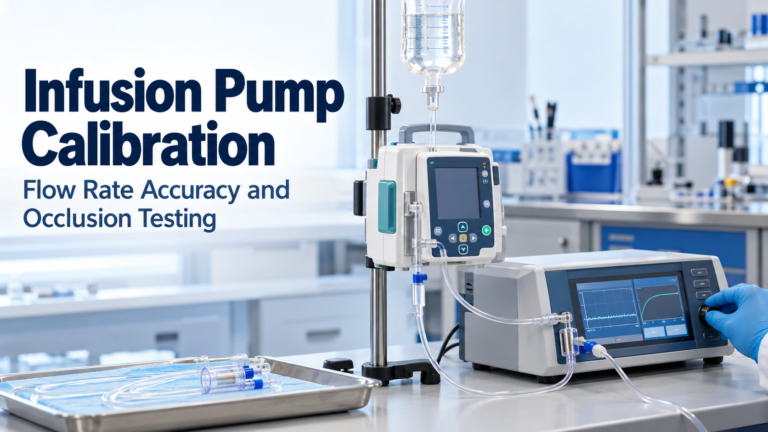
The pump is connected to a traceable infusion device analyser using the syringe size and brand normally used in your hospital. The analyser measures flow and volume over time and creates a controlled occlusion to test alarm pressure. Results are compared with the manufacturer’s tolerance and recorded with measurement uncertainty on a certificate.
Because low-rate testing needs more time to collect enough volume, planning matters. We usually test several pumps at once to keep the visit efficient.
How often to calibrate
Annual calibration is common, with extra checks after repair or if a pump is dropped. Pumps used for high-risk infusions or in neonatal units may warrant more frequent testing. Our infusion pump calibration article covers the related volumetric pumps.
Good practice between calibrations
Syringe pump accuracy depends partly on how the pump is used. A few habits help keep infusions accurate between calibrations:
- Select the correct syringe: always confirm the size and brand shown on the screen match the syringe loaded.
- Seat the syringe properly: the barrel clamp and plunger holder must be fully engaged, or the first minutes of infusion may deliver less than expected.
- Prime the line: removing slack from the drive before starting reduces start-up delay, which matters at low rates.
- Keep the pump level: large height differences between pump and patient can cause siphoning or delivery changes.
- Clean and inspect: spilled fluids can affect the drive and sensors; report any sticky or noisy movement.
Share these points during staff training and include them in your pump checklist. Combined with annual calibration using a traceable analyser, they give the best protection for precise, low-volume infusions in ICU, NICU and theatre. Our onsite calibration visits can include a short briefing for nursing staff.
A worked example: low-rate syringe pump testing
Suppose a neonatal unit uses syringe pumps at very low rates for continuous drug infusions. A meaningful calibration must test those rates, not just a convenient high rate. The engineer loads the syringe size and brand used on the unit, selects it on the pump, and connects to an infusion device analyser. Because volumes are small, the analyser needs longer to collect enough fluid for an accurate result. Running several pumps in parallel keeps the visit efficient.
The engineer records flow error at the low rate and at a typical higher rate. An occlusion test measures the alarm pressure and time to alarm. At low rates, time to occlusion alarm can be long, which is useful information for clinical staff when setting occlusion limits. Finally, near-empty, end-of-infusion and syringe-disengaged alarms are checked.
Common problems found in syringe pumps
- Syringe brand set incorrectly on the pump, leading to volume errors.
- Worn plunger clamps or barrel clamps that do not hold the syringe firmly.
- Drive mechanism wear causing uneven delivery.
- Dirty or damaged sensors that detect syringe size or plunger position.
- Battery problems in pumps used for transfers.
Syringe libraries and brand changes
If your hospital changes syringe supplier, the new brand must be available in the pump’s syringe library and selected correctly by staff. Check this before the new syringes reach clinical areas, and consider a short verification of delivery accuracy with the new brand. Record the approved syringe brands in your equipment file so future calibrations use the same ones.
What good records look like
For each syringe pump, record the asset number, location, syringe brand used for testing, measured flow error at each rate, occlusion results and any parts replaced. Over time, these records show which pumps drift and which models are most reliable, supporting informed replacement plans.
Preparing syringe pumps for calibration
Syringe pump calibration depends on using the right syringes, so preparation starts there. Supply the engineer with the syringe sizes and brands used in each clinical area, especially neonatal, ICU and theatre. Make sure pumps are clean, charged and returned with their mounting clamps. Tag any pump with a reported fault so it can be investigated during the visit.
Because low-rate tests take time, agree a realistic schedule with the provider and plan which pumps will be tested together. Keep enough calibrated pumps on each unit for current patients, and rotate the rest through testing in batches. When pumps return to service, confirm that the correct syringe library is loaded and that the calibration label shows the new due date.
Finally, share any failures with the clinical teams. If a particular model or syringe combination shows repeated problems, the biomedical, pharmacy and nursing leads can decide together on changes to practice or equipment.
Training staff to support accuracy
Short, practical training sessions make a real difference to syringe pump accuracy. Cover how to select the correct syringe brand, how to seat the syringe and plunger properly, why the line should be primed before starting, and how occlusion alarms behave at low rates. Include new staff in induction, and refresh the session whenever a new pump model or syringe brand is introduced. Combining training with the annual calibration visit is an efficient way to reach the teams who use the pumps every day.

Frequently asked questions
Why does syringe brand matter?
Syringes of the same nominal size can have slightly different diameters. The pump must be set to the brand in use to calculate volume correctly.
Can syringe pumps be tested at low rates?
Yes. Low-rate tests take longer but are important, especially for neonatal and critical care use.
Is on-site calibration possible?
Yes. Syringe pumps are routinely calibrated on-site with a portable analyser. See our onsite calibration services.
What if a pump fails?
It should be withdrawn, repaired and re-tested before use, with the result recorded.
Do PCA pumps need the same checks?
Patient-controlled analgesia pumps need delivery accuracy and alarm checks, plus verification of bolus and lockout functions.
Why does time to occlusion alarm matter?
At low rates, pressure builds slowly after a blockage, so alarms can take longer. Knowing this helps staff set appropriate occlusion limits and check lines regularly.
Conclusion
Syringe pump calibration protects precise, low-volume infusions where accuracy matters most. Testing with your own syringes and a traceable analyser gives results you can rely on.
External reference: NABL India.
Plan your pump calibration with Vanavil Calibrations’ medical equipment calibration service. Contact us.